.png)

Running field operations across multiple sites means juggling a lot of moving parts. Crews in the field, budgets that need to stay current, projects that span months, and a finance team that has to close the books on time.
Most operations teams end up with two essential systems at the center of that work. One is an accounting platform that owns all financial and labor data, ideally with time-tracking built in, such as QuickBooks with QuickBooks Time. The other is a field-aware project-management platform like Matidor that keeps operations coordinated day to day.
The question is not whether you need both. You almost certainly do. The real question is how they should relate to each other, which system should be the source of truth for time and cost, and how to connect them so that data never has to be entered twice.
What Each System Actually Does
Before talking about integration, it helps to be clear on what each system is designed to do.
Accounting with Built-In Time-Tracking
An accounting system is where the financial record of your organization lives. It manages payables and receivables, general-ledger entries, invoicing, payroll, tax records, and financial statements.
In many modern stacks, this system also includes integrated time-tracking. Examples include QuickBooks with QuickBooks Time and project-accounting suites like Deltek Vantagepoint with timesheets built into the same platform. In this setup, employees record their hours directly in the accounting environment. Those hours then drive payroll, billing, and project-cost allocations without any export or re-entry.
This combined platform becomes the single system of record for:
- Timesheets and labor hours
- Payroll calculations
- Client invoicing based on billable hours
- Project- and cost-code-level labor costs
It is not responsible for daily task coordination, crew scheduling across sites, or portfolio-level project tracking for field operations. That is the job of the project-management system.
Project Management for Field Operations
Project-management software organizes the work itself. It manages tasks, milestones, schedules, resource assignments, documentation, and team communication.
In field operations, a purpose-built platform also needs to handle offline mobile work, GIS-based site visualization, compliance documentation, and real-time status updates across dozens of concurrent sites.
Matidor’s project-management module is designed around multi-site portfolios, map-based views, and budgeting dashboards that reflect actual spending as it happens.
Project management answers questions like:
- Who is working where today
- Which sites are at risk of falling behind
- How current field spending compares to the live budget
- Which tasks and permits are blocking progress on a given site
It does not generate payroll files, process invoices, or maintain the general ledger.
Why Accounting and Time-Tracking Belong Together
Time-tracking and accounting are natural partners. Hours worked become labor costs, those costs appear on invoices and budgets, and everything has to reconcile inside the financial system.
When time-tracking is integrated directly into the accounting platform, several important things happen automatically:
- Payroll accuracy improves. Approved timesheets flow straight into payroll runs. Manual data entry disappears, and the risk of paying the wrong amount because of a typo drops sharply.
- Client invoicing becomes precise. Billable hours captured in the field pull directly onto invoices. You avoid missed time, inflated hours, and complicated reconciliations.
- Labor costs hit project budgets in real time. When a field tech logs six hours against a project, that labor cost lands on the right job and cost code immediately, instead of waiting until month end.
The ideal setup is to choose a single accounting platform that handles both time-tracking and accounting natively. QuickBooks with QuickBooks Time and Deltek Vantagepoint with its timesheet and accounting modules are examples of this combined model. In this architecture, hours, payroll, invoicing, and financial records all live in one system of record.
That accounting-plus-time platform becomes the authoritative source for all labor and financial data. There is no separate standalone time-tracking system to wire in or maintain.
From there, a one-way integration pushes cost and labor data into the project-management platform. Operations teams gain real-time budget visibility without ever touching payroll settings or re-typing numbers. The accounting system stays responsible for accuracy and compliance. The project-management system consumes that data so project managers can control work and budgets.
Why Accounting and Project Management Work Best as Two Separate Systems
Some vendors try to position a single tool that does it all. For field operations, this usually creates more problems than it solves.
Accounting with integrated time-tracking and project management solve different problems for different audiences:
- Accounting serves finance, executives, and auditors
- Project management serves operations, project managers, and field crews
When you merge them into one monolithic system, you often end up with:
- Finance teams stuck in interfaces designed for task boards
- Operations teams forced into complex ERP-style screens that were never meant for field users
- Slower implementations and higher change-management overhead
A two-system approach is both cleaner and more resilient:
- The accounting platform owns money, time, and compliance.
- The project-management platform owns work, schedules, and coordination.
The integration between them becomes a simple, reliable pipe instead of a tangle of overlapping responsibilities.
With Matidor, for example, accounting systems like QuickBooks Online and Deltek Vantagepoint remain the system of record. Matidor syncs with them so that project budgets and cost dashboards always reflect actuals without replacing your existing financial stack.
Why Time-Tracking Should Stay Out of the Project-Management System
Many project-management tools include a simple time-logging feature. It is tempting to use that as the primary record of hours worked. For field operations, this usually creates hidden risk.
The issue is not whether a project-management tool can store hours. It is what those hours need to satisfy:
- Payroll-compliance rules
- Labor regulations
- Overtime calculations
- Union or contract rules
- Audit requirements
These are finance and HR problems, not project-scheduling problems.
In the ideal architecture:
- Time-tracking lives inside the accounting environment. Employees clock in and out, or submit timesheets, in the same platform that will pay them and bill clients, such as QuickBooks Time.
- Project management receives a one-way feed of that data. Approved hours and labor costs flow into the field-operations platform so project managers see the financial impact without touching the raw timesheets.
This separation keeps the source of truth clear. Accounting holds definitive time and cost records. Project management displays those records in a way that is useful for coordination and control.
Trying to flip this, and treat project management as the primary time system, usually leads to:
- Limited or fragile payroll integrations
- Missing GPS or compliance controls that specialized time modules provide
- Data-governance issues when sensitive payroll data is visible in tools that many non-finance users touch
Matidor is intentionally designed not to replace your finance-side time-tracking. Instead, it connects to accounting systems that already handle time and payroll, then allocates labor costs to the right projects and sites automatically.
If you want to go deeper on this architecture, see: Field Service Software & Financial Tool Integration.
How One-Way Integration Eliminates Duplicate Entries
The biggest practical benefit of this two-system model is the removal of duplicate data entry.
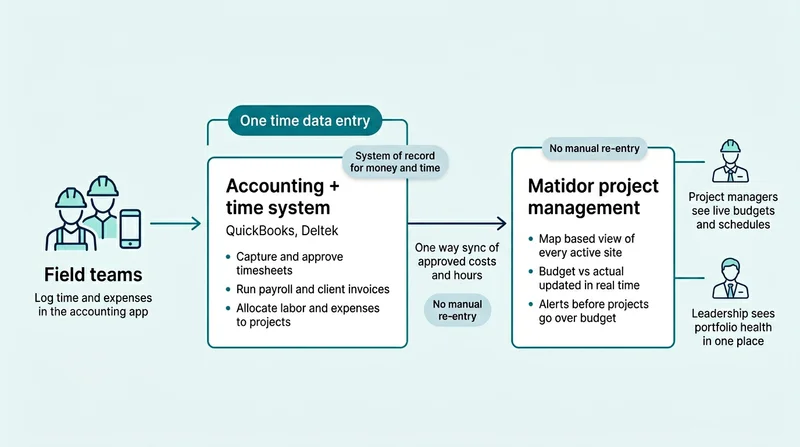
In a well-designed integration:
- Field staff enter time once in the accounting system that includes time-tracking.
- Finance approves timesheets and runs payroll in that same system.
- Project codes and cost codes are shared between accounting and project management so that costs can map cleanly.
- Approved labor and expense data sync one way into Matidor, where project budgets and dashboards update in real time.
Nobody in operations needs to re-type hours, re-enter invoices, or manually rebuild budgets from spreadsheets at month end. The accounting system remains the source of truth. Matidor reflects it.
This is exactly how Matidor integrates with QuickBooks Online, Deltek Vantagepoint, Harvest, and Replicon today. Expenses and labor costs flow from accounting into Matidor in real time. Project budgets in Matidor map directly to the chart of accounts so cost codes stay aligned.
The result is live budget visibility for project managers, with finance-grade accuracy that still lives where it belongs.
For an example of how this impacts reporting speed, see: How to Track Field Project Budgets in Real-Time.
What To Look For When Choosing These Systems
When you build a stack around two systems instead of three, your selection criteria become clearer.
For Your Accounting-Plus-Time Platform
Look for:
- Native time-tracking. Hours and timesheets should be part of the accounting product, not a bolted-on afterthought.
- Field-friendly time capture. Mobile apps, GPS support, and offline capability matter when crews are remote.
- Project-level cost tracking. The system should apply labor and expenses to specific projects, cost codes, or AFEs so that downstream tools can show accurate budgets.
- API access and integrations. You should be able to connect the accounting system cleanly to external platforms like Matidor.
For Your Project-Management Platform
Look for:
- Built for field operations. Offline-first mobile apps, GIS visualization, and support for multi-site portfolios are critical. See Matidor’s field-operations capabilities.
- Real-time budget visibility. The tool should show budget-to-actual status using data from your accounting system without manual uploads, like Matidor’s Budget & Cost Control.
- Integration-first design. It should expect accounting to be the financial source of truth and treat synced data accordingly.
- Fast implementation. You should be able to go live in weeks rather than months so that value shows up quickly. See the Get Started guide.
The Right Stack for Field Operations
When you zoom out, the recommended architecture looks like this:

You are not choosing between three overlapping systems. You are choosing two that are very clear about their responsibilities, then connecting them in a way that keeps data flowing and ownership simple.
Accounting with integrated time-tracking owns money and time. Matidor owns work and visibility. A one-way sync between them eliminates duplicate entry while still keeping the financial source of truth separate and intact.
When that is in place, real-time visibility replaces month end surprises, and both finance and operations can work from the same numbers with confidence.
Matidor is a GIS-native field-operations platform that connects your accounting-and-time system to live project budgets, schedules, and site data. Explore the platform, or book a discovery session to review your stack with our team.
.webp)
.webp)
.webp)
.webp)
.webp)
.webp)
.webp)
.webp)
.webp)
.webp)

.webp)
.webp)
.webp)
.webp)
.webp)
.webp)
%20(2).webp)
.webp)
.webp)
.webp)

















.webp)

.webp)


.jpg)


%20(1).webp)



.jpg)

.jpg)
.jpg)
.jpg)


.jpg)