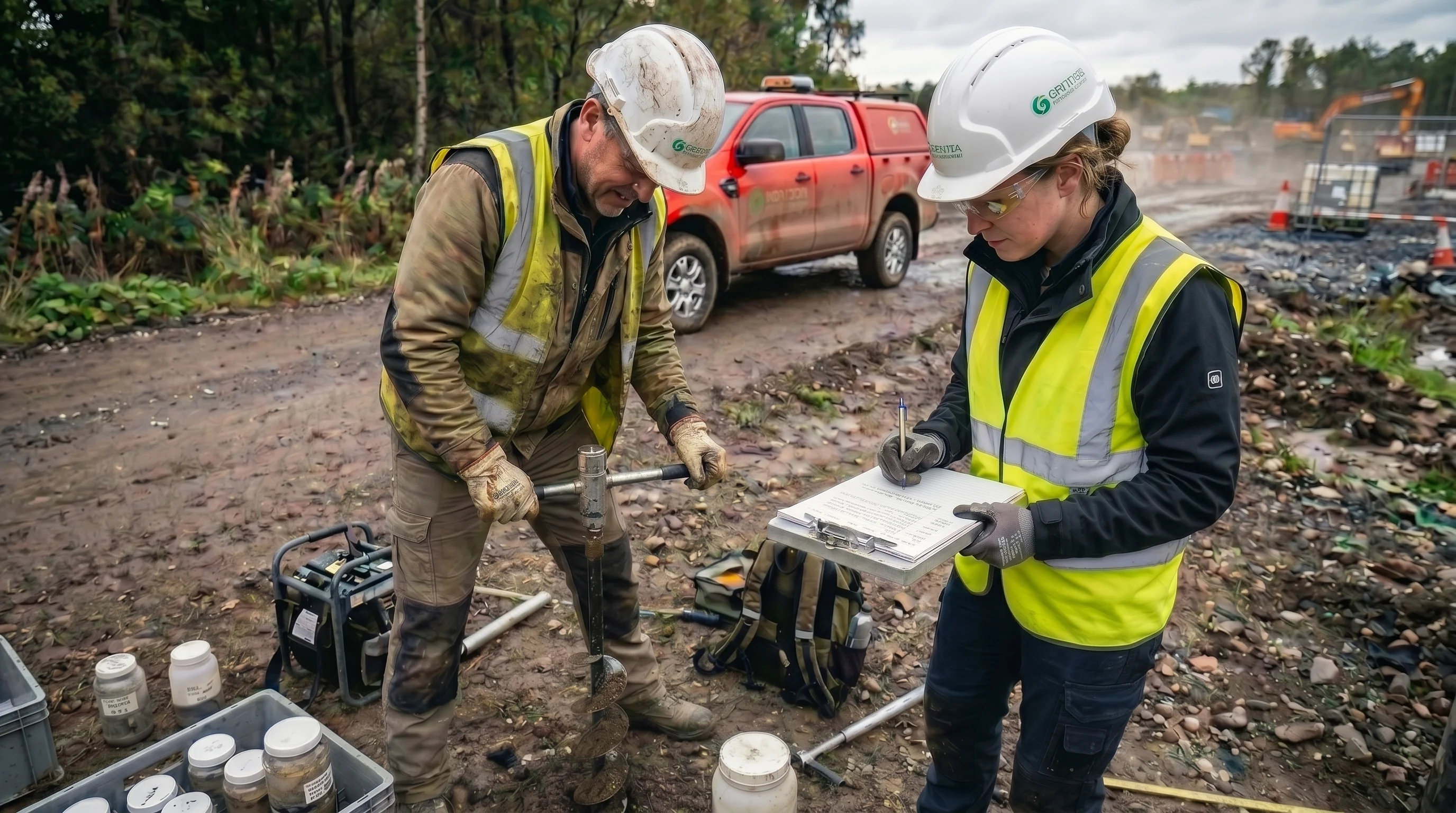

Coordinating contractor teams across 10, 30, or 100-plus active field sites is one of the most structurally difficult challenges in field operations management in 2026. Contractors need enough access to do their work. They should not have access to other clients' data, financial controls, or project settings they have no role in. This guide is written for oil and gas operators, environmental consulting project managers, and construction and engineering teams who manage multiple contractor organizations across concurrent field projects and need a practical framework for doing it without losing control of cost, documentation, or data.
This article covers why contractor coordination breaks down as site count grows, what structured contractor management requires, and how field operations teams can replace ad hoc coordination with controlled, auditable workflows.
Why contractor coordination breaks down at scale
A single-site operation with one primary contractor can function on email and phone calls. At 20 or more active sites with multiple contractor organizations, the coordination model that worked at small scale creates compounding problems.
Most field operations teams reach this point and solve it badly: they share platform credentials, copy relevant data into email threads, or give contractors full access and manage the exposure manually. All three approaches create audit gaps, data integrity risks, and coordination overhead that grows with the size of the contractor base.
The specific failure points are consistent across industries:
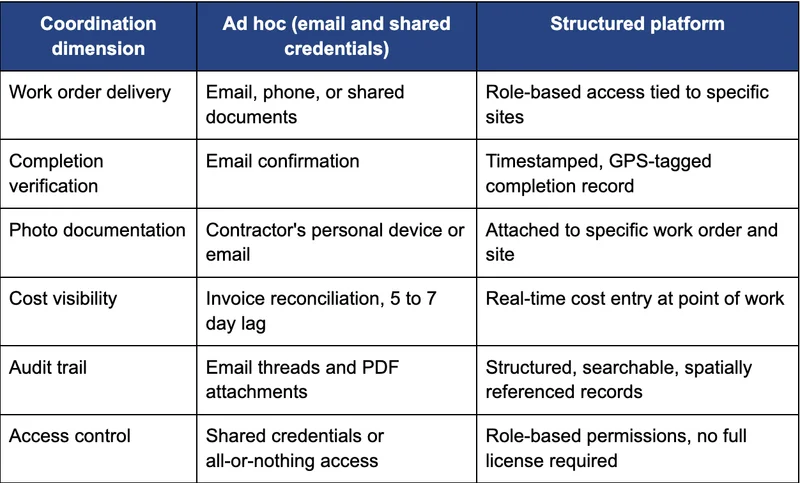
- Contractors receive work orders by email and confirm completion the same way, with no structured record
- Site managers have no live visibility into what contractor teams have completed at remote locations
- Cost entries from contractor work arrive days after the fact, through invoice reconciliation rather than real-time reporting
- Photo documentation from contractor site visits lives in individual phone camera rolls, not attached to the specific site and work order
- Access to project information is all-or-nothing: either contractors are in the platform with full visibility, or they are managed entirely outside it
Each of these problems scales linearly with the number of active sites and contractor relationships.
What the regulatory and audit environment expects
In oil and gas and environmental consulting, contractor documentation is not just an internal operations concern. Regulators and clients increasingly expect that the records associated with contractor work, completion evidence, inspection forms, photos, and cost entries, are traceable, timestamped, and attached to the specific site and work order they relate to.
In Canada, Energy Safety Canada's contractor management guidelines identify six core steps for managing contractors and service providers, with record-keeping and due diligence named as a required final step. Environmental consulting firms managing subcontractors on regulated site assessments or remediation projects are expected to maintain documented oversight of subcontractor scope, schedule, budget, and quality across all active assignments. When contractor records exist only in email threads, PDF attachments, and phone camera rolls, assembling that evidence for a regulator or client audit becomes a significant manual exercise with real risk of gaps.
Four capabilities of structured contractor management
Effective contractor management for multi-site field operations requires four structural capabilities. Most organizations have some version of one or two of them. Getting all four working together is what makes a program defensible at scale.
1. Role-based access tied to specific assignments
Contractors need access to their specific work orders, the sites they are assigned to, and the documentation tools relevant to their scope, nothing more. Giving contractors full platform access creates data integrity and confidentiality risks. Managing them entirely outside the platform creates an audit gap. Role-based access solves both problems: contractors see what they need and nothing else, without requiring full platform licenses or exposing financial data, other clients' projects, or administrative settings.
This also matters for multi-client operations. Environmental consulting firms managing site assessments for several clients concurrently need clear data separation between projects, even when the same subcontractor is working on multiple assignments.
2. Work orders tied to specific site locations
A work order that exists only in an email has no geographic context, no audit trail, and no reliable way to verify completion. Work orders tied to specific site locations give contractors the context they need to complete the work correctly, give operations managers real-time visibility into assignment status, and create the documentation record that compliance and billing both require.
Geographic context matters specifically in multi-site field operations because contractors moving between sites need clear, site-specific instructions rather than general scope documents. A work order attached to a specific location, with site photos, access notes, and relevant forms available at that location, reduces the coordination overhead that currently runs through phone calls and email threads.
3. Offline-first mobile documentation for field crews
Contractor teams completing work at remote sites need the same offline-first mobile capability as internal field crews. Standardized forms, GPS-tagged photos, and timestamped completion records should be available to contractor teams regardless of connectivity, and should sync directly to the relevant work order in the central platform, not to a personal device or a shared email thread.
The documentation standard is what makes a contractor completion record auditable rather than just acknowledged. A timestamped, GPS-tagged photo attached to a specific work order at a specific site is a defensible record. An email that says "done, photos to follow" is not.
4. Real-time cost entry at the point of work
The gap between when contractor work happens and when its cost appears in the project record is one of the primary sources of budget overruns on multi-site field operations. Platforms that rely on invoice reconciliation as the primary cost entry mechanism will always lag actual spend by five to seven days or more.
Structured contractor management includes cost entry at the point of work, either by the contractor directly or by a site supervisor, feeding into the live budget dashboard immediately. This gives operations managers the ability to see actual spend against budget in real time rather than discovering overruns after the invoice arrives.
Ad hoc vs. structured contractor coordination
Why environmental consulting teams face this challenge first
Environmental consulting firms routinely coordinate multiple subcontractor organizations across concurrent site assessment, monitoring, and remediation projects. Each subcontractor needs access to their assigned sites, their specific forms and work orders, and the documentation tools for their scope, but not to other clients' projects or financial data.
Without structured contractor portals, environmental project managers spend significant time each week forwarding forms, chasing completion confirmations, and manually compiling contractor documentation into client reports. The coordination overhead is not a people problem. It is a structural problem: the platform does not support the kind of role-based, site-specific access that multi-client, multi-subcontractor operations require.
With structured portals and mobile field tools, that workflow runs inside the platform. Client-ready reporting becomes an aggregation exercise rather than a compilation exercise.
Oil and gas operations face the same structural challenge at a different scale. A producer managing 50-plus active well sites with separate contractors for reclamation, inspection, and maintenance work needs the same separation of access, the same geographic work order structure, and the same real-time cost visibility, just across a larger and more geographically dispersed portfolio.
How technology supports structured contractor management
A GIS-native field operations platform handles the four structural requirements above in ways that generic project management tools or email-based coordination cannot. The key difference is that every work order, form, photo, and cost entry is spatially referenced, tied to a specific site on a live map, rather than stored as a file or email with no geographic context.
When contractor access, work orders, documentation, and cost tracking all live in the same platform and connect to the same map, the coordination overhead that currently runs through email and phone calls moves inside the system. Operations managers get live visibility without chasing updates. Contractors get clear, site-specific instructions without needing to call the office. The audit trail is built automatically as work happens, not assembled manually after the fact.
For more on building field operations programs that scale across large site portfolios, see Matidor's guides on environmental consulting reporting and mitigating major risks in oil and gas.
Next steps for operations teams
The first step is an honest audit of how contractor coordination currently works: Where do work orders originate and how are they confirmed? Where does contractor documentation end up? How long does it take for contractor costs to appear in the project record? If the answers involve email, shared drives, and invoice reconciliation, the gap is structural, not operational.
For teams managing 20 or more active sites with multiple contractor organizations, Matidor's field operations platform and project management tools are built specifically for this. Role-based contractor access, GIS-linked work orders, offline mobile documentation, and real-time budget tracking work together in one platform. See also Matidor's solutions for environmental services and oil and gas operations.
Additional reading: How to Manage 50-Plus Field Projects Without Losing Control and Field Operations Software Buyer's Guide.
Ready to Replace Email-Based Contractor Coordination?
- Start a free 14-day trial and set up your first contractor portal in under an hour
- Book a demo to see contractor portals, work order management, and mobile field tools configured for your operation
- Evaluate platform fit with Matidor's self-guided discovery tool
Frequently Asked Questions
Why does contractor coordination break down when site count grows past 20?
At small scale, email and phone coordination is manageable because a single project manager can track all active assignments manually. As site count grows, the number of active contractor relationships, work orders, and documentation requests multiplies faster than coordination capacity. The result is a predictable set of failures: unverified completions, delayed cost visibility, scattered documentation, and inconsistent access control that creates audit risk.
What is a contractor portal and how is it different from a shared login?
A contractor portal is a role-based access layer that gives a specific contractor organization visibility into only the sites, work orders, and tools relevant to their scope. A shared login gives contractors access to the full platform with no differentiation by role or assignment. Contractor portals eliminate the confidentiality and data integrity risks of shared access while keeping external teams inside a structured, auditable system.
How does real-time cost entry reduce budget overruns on multi-site operations?
Invoice reconciliation introduces a lag of five to seven days or more between when work is done and when its cost appears in the project record. During that lag, a project manager has no accurate view of actual spend against budget. Real-time cost entry at the point of work closes that gap, giving operations managers the ability to identify and respond to overruns before they compound across multiple sites.
What documentation does a regulator or client typically expect for contractor work?
In oil and gas and environmental consulting, contractor documentation should include a dated work order tied to a specific site, timestamped completion evidence (photos, inspection forms, or field notes), GPS coordinates confirming where documentation was captured, and a clear record of who completed the work and when. Documentation that lives in email threads or personal devices is difficult to compile into an audit package and easy to challenge.
.webp)
.webp)
.webp)
.webp)
.webp)
.webp)
.webp)
.webp)
.webp)

.webp)
.webp)
.webp)
.webp)
.webp)
%20(2).webp)
.webp)
.webp)
.webp)

















.webp)

.webp)


.jpg)


%20(1).webp)




.jpg)

.jpg)
.jpg)
.jpg)


.jpg)