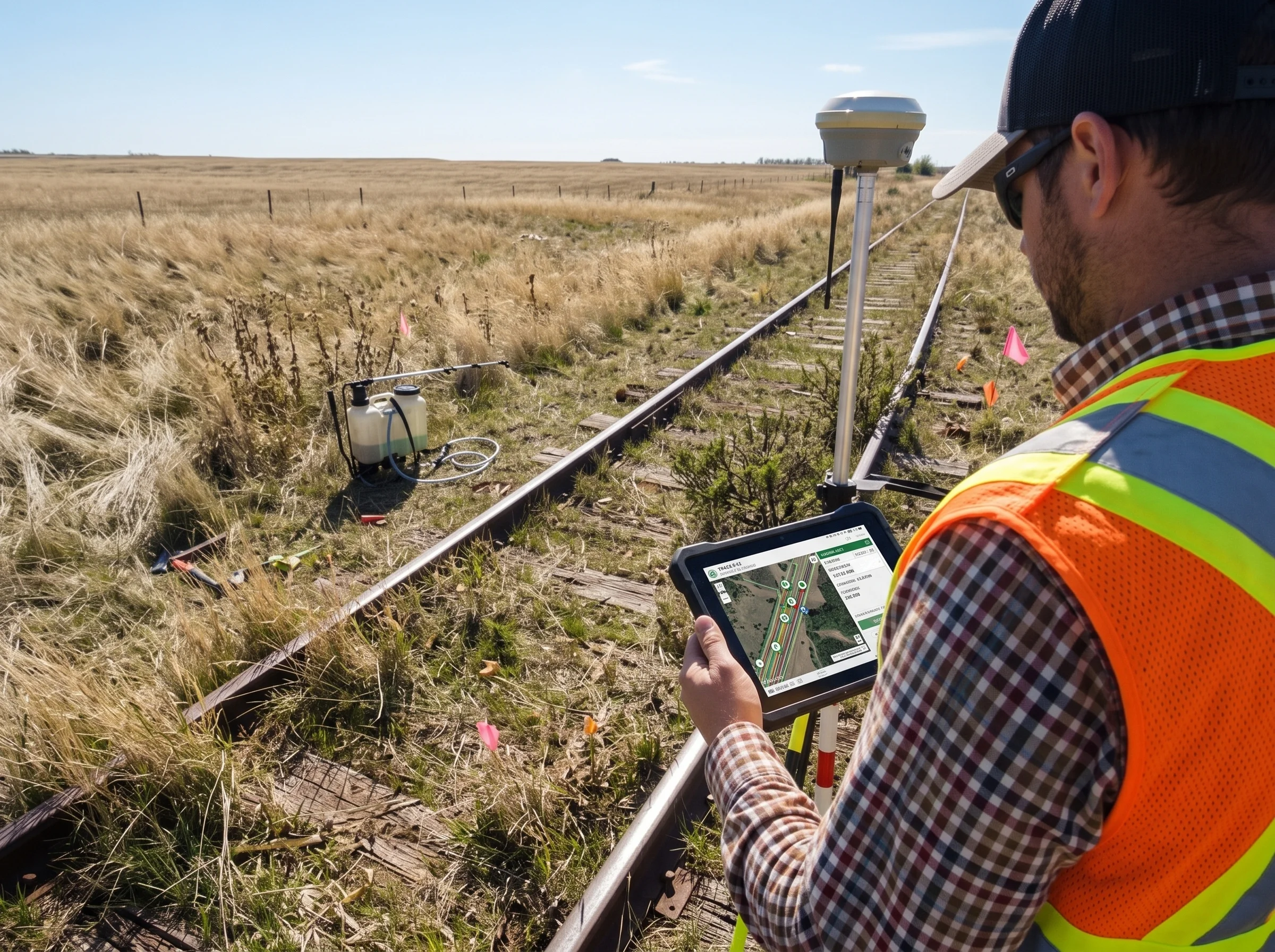

Field inspection reports are the documentary backbone of oil, gas, and environmental operations. They are also the place where most multi-site operations teams have their biggest documentation gap. Crews complete inspections in the field. The data does not make it into a central system in usable form. When a regulator requests records or a client asks for a status summary, the exercise of assembling that evidence is expensive, slow, and never fully clean.
This guide covers what a compliant, audit-ready field inspection record looks like, why paper and PDF-based workflows fail at scale, and how to build a documentation system that holds up to regulator review across 10, 30, or 100-plus active sites.
What regulators actually expect from field inspection records
Field inspection records are not just an internal operations tool. In Canada, both the Alberta Energy Regulator and the Canada Energy Regulator have specific expectations about what an inspection record must contain and how it must be maintained.
The AER's inspection and enforcement program gives field inspectors the authority to require that information, data, records, reports, and documents be provided, and to remove those records from site for examination. Operators are expected to maintain documentation that reflects actual conditions at each stage of a site's lifecycle, from construction through operation to closure. Under the updated SED 002 (released July 2025), reclamation certificate applications now require documentation aligned with the AER's OneStop submission process, with supporting records that must demonstrate compliance against current criteria and guidelines.
The CER requires federally regulated pipeline companies to conduct inspections on a regular basis and audits with a maximum interval of three years. Operators must maintain operation and maintenance manuals and submit them to the Regulator when required. The BCER's Field Site Inspection Procedure Form sets out the specific items inspectors verify on-site, including drainage structures, road prism stability, signage requirements, spill response evidence, wellhead condition, and surface casing vent status, all of which require documented field verification.
Canada's updated methane regulations, effective in phases through 2028, require higher-risk upstream oil and gas facilities to conduct quarterly instrument-based leak inspections, with monthly screening in any month where the facility is visited. All inspections require maintaining detailed records of inspection dates, findings, repair actions, and emissions reductions. That is a documentation frequency that paper-based workflows cannot sustain reliably at scale.
The common thread across all three regulatory frameworks is the same: inspection records must be traceable, timestamped, attached to a specific site, and retrievable on demand. Email threads and PDF attachments stored on personal devices do not meet that standard.
Why paper and PDF workflows fail at scale
At a single-site operation with a small inspection program, paper forms and PDF reports are manageable. A field technician completes the form, it gets scanned and emailed to the office, someone files it in the project folder, and the records are reasonably complete.
At 20 or more active sites with multiple inspection programs running concurrently, each step in that chain introduces a failure point that compounds across the portfolio. The specific failure modes are consistent:
- Forms completed in the field do not get returned to the office for days, sometimes weeks after the site visit
- Scanned or photographed forms arrive without the GPS location, date, or inspector signature clearly legible
- Photos documenting site conditions are stored in personal camera rolls or emailed separately from the form, creating two records that need to be manually reconciled
- When a form is revised (inspection criteria change, a new regulatory requirement is added), crews in the field continue using old versions until the update is physically distributed
- At a multi-site program level, there is no way to know what percentage of scheduled inspections have been completed, where findings are outstanding, or which sites have overdue corrective actions without manually chasing each site individually
Manual inspection systems break at scale because modern operations have outgrown traditional workflows. As the number of sites grows and inspection frequency increases, the coordination overhead grows faster than the team's capacity to manage it.
What a compliant, audit-ready inspection record contains
An inspection record that holds up to regulator review has six components. Most paper and PDF-based records are missing at least two of them.
1. Clear site identification
The record must be unambiguously tied to a specific site, with the legal land description, GPS coordinates, or site identifier that matches the regulatory filing for that location. A form labeled "north pad site" with no further geographic reference is not sufficient.
2. Timestamped completion
The date and time the inspection was conducted, recorded at the time of the inspection, not filled in later. For inspection programs with mandatory frequencies, such as monthly LDAR screening or quarterly OGI surveys, timestamps are the primary evidence that the schedule was met.
3. Inspector identification
The name and role of the person who conducted the inspection. Regulators need to know who inspected what and whether that person had the qualifications required for that inspection type.
4. Completed checklist against current criteria
The actual inspection items evaluated, with pass, fail, or not applicable noted for each item against the current version of the applicable criteria. Out-of-date forms are a common finding in regulatory audits and can invalidate otherwise compliant inspection records.
5. GPS-tagged photo documentation
Photos showing the conditions observed, attached to the specific inspection record and location, not stored separately in a personal device or email. Regulators and clients will ask to see photos as supporting evidence for both compliant and non-compliant findings.
6. Corrective action status
For any finding that requires corrective action, the record should show the required action, the person responsible, the deadline, and the completion status. An open finding with no assigned owner and no due date is not a defensible record.
The four failure points that appear in multi-site inspection programs
Data that never makes it to a central system
Inspection data captured on paper, PDF, or a personal phone camera roll exists only at the field level until someone manually transfers it to the project record. That transfer step is where data gets lost, delayed, or never completed. At 50-plus sites with multiple inspection types running concurrently, the manual transfer burden is unsustainable.
Forms that lag regulatory updates
When form updates require physical distribution to field crews, there is always a gap between when a change takes effect and when crews in the field are using the updated version. The AER rescinded Manuals 001, 002, and 005 effective June 2026. Using a superseded form is a compliance risk regardless of whether the underlying inspection was conducted correctly.
No real-time program visibility
An operations manager overseeing 30 active sites needs to know what percentage of scheduled inspections are complete, which sites have outstanding findings, and which corrective actions are overdue. Paper and email-based programs cannot provide this without significant manual aggregation. By the time the picture is assembled, the data is already stale.
Photo documentation not attached to the record
Photos taken in the field and stored in a personal camera roll are not part of the inspection record until someone manually attaches them. When a regulator or client requests photos from a specific site visit, finding and producing them becomes a manual excavation exercise with real risk of gaps.
What structured multi-site inspection tracking requires
Standardized digital forms tied to site locations
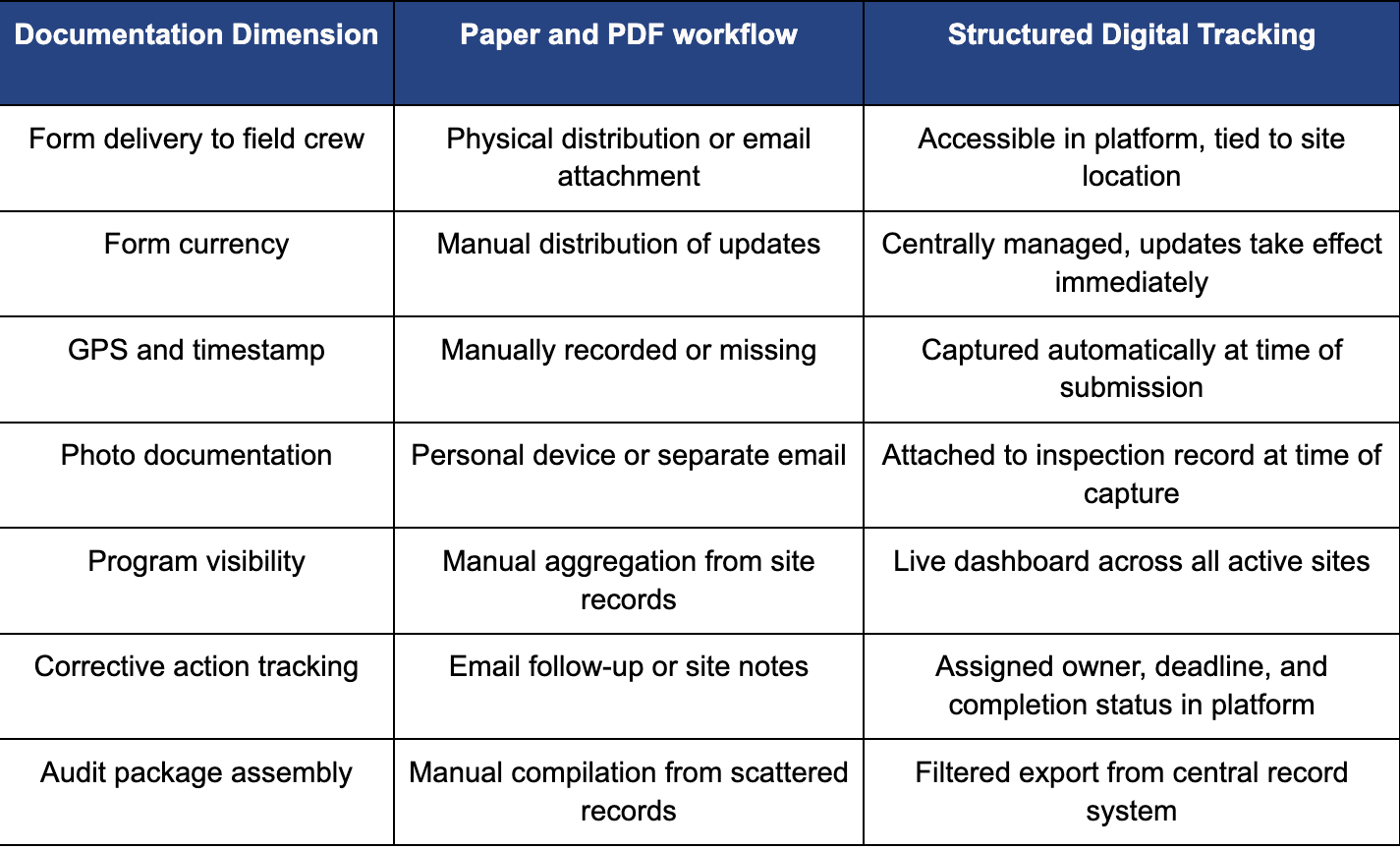
Forms live in the platform, tied to the specific site they apply to. Field crews access the correct form for the site they are visiting without carrying paper or downloading files in advance. When regulatory criteria change, updates publish centrally and take effect immediately across all sites.
Offline-first mobile capture with automatic GPS and timestamp
Forms are completable without connectivity. GPS coordinates and timestamps are recorded automatically at submission, not filled in manually. Photos taken during the inspection attach to the record in the same step, not emailed separately.
Real-time program visibility at the portfolio level
Operations managers see a live view across all active sites: inspections complete, overdue, outstanding findings, and corrective actions approaching deadlines. No manual aggregation required.
Corrective action tracking with assigned owners and deadlines
Every finding generates a task with an assigned owner, a deadline, and a completion status visible to both the field team and the program manager. Corrective actions tracked through email follow-up have no accountability mechanism and create audit exposure when regulators ask for closure evidence.
Structured vs. Unstructured Inspection Tracking
Environmental consulting teams and the inspection documentation challenge
Environmental consulting firms managing site assessment, remediation, and monitoring programs face the inspection documentation challenge at a particular level of complexity. Each project has its own inspection schedule, its own regulatory framework, and its own client reporting requirements. Subcontractors may be conducting inspections on behalf of the consulting firm, adding an additional layer of documentation that needs to be integrated into the central project record.
Without structured inspection tracking, environmental project managers spend significant time each week chasing field data from subcontractors, manually compiling inspection records into client deliverables, and assembling audit packages from records scattered across email threads, shared drives, and personal devices. The administrative burden is not the main risk. The main risk is that the records assembled from that process are incomplete, inconsistent, or not traceable to the specific site and inspection date they claim to document.
With structured inspection tracking, the field data flows directly into the project record as inspections are completed. Client reports become an aggregation of records that already exist in structured form, rather than a compilation exercise that requires manual validation of every individual record.
Oil and gas operators and frequency-driven inspection compliance
For oil and gas operators managing large site portfolios, the 2026 regulatory environment has significantly increased inspection frequency requirements. Under Canada's updated methane regulations, higher-risk upstream facilities must now be inspected quarterly using OGI cameras or equivalent instruments, with monthly screening in any month where the facility is visited. Single wellhead sites require at minimum quarterly AVO surveys.
Managing that inspection frequency across a large portfolio on paper is not operationally viable. A producer with 200 active sites running quarterly OGI inspections generates at minimum 800 inspection records per year before accounting for monthly screening requirements. Those records need to be complete, timestamped, traceable to specific sites, and retrievable on demand for regulatory review. A paper-based program cannot reliably produce that documentation at that volume.
Digital inspection tracking with offline-capable mobile capture is not a convenience at that scale. It is a compliance requirement.
Building an inspection documentation system that holds up
The starting point for any inspection documentation improvement is an honest assessment of the current state: What percentage of completed inspections have a complete, retrievable record in the central system? How long does it take to assemble an audit package for a single site? Are photos from field inspections attached to the relevant inspection records? Are corrective actions tracked with assigned owners and deadlines?
For most multi-site operations teams, the honest answers to those questions reveal a documentation program that is functioning at a fraction of its intended compliance value. The individual inspections are being conducted. The records are not in a state that supports regulatory review.
For operations teams ready to build a structured inspection tracking system, Matidor's field operations platform and location intelligence tools are designed specifically for this. GIS-native site management, offline-first mobile forms, automatic GPS and timestamp capture, and portfolio-level program visibility work together in one platform. See also Matidor's solutions for environmental services and oil and gas operations.
Additional reading: How to Manage Contractor Teams Across Multi-Site Field Operations and Field Operations Software Buyer's Guide.
Ready to Build an Audit-Ready Inspection Program?
- Start a free 14-day trial and run your first structured inspection program in under a day
- Book a demo to see offline mobile forms, GPS capture, and portfolio-level inspection dashboards configured for your sites
- Evaluate platform fit with Matidor's self-guided discovery tool
Frequently Asked Questions
What is the difference between an inspection and an audit in the context of AER compliance?
Under the AER's inspection and enforcement program, inspections are on-site verification activities where field inspectors review a site against legislative requirements. Audits are formal reviews of information submitted to the AER, such as applications, reports, and notifications, for accuracy and compliance. Operators need documentation systems that support both: field-level inspection records that are retrievable and complete for on-site review, and structured reporting that supports formal audit submissions.
How often are oil and gas operators in Canada required to conduct field inspections in 2026?
Inspection frequency under Canada's updated methane regulations depends on facility classification. Higher-risk upstream facilities, including those with tanks, compressors, and pneumatic controllers, must conduct quarterly OGI or instrument-based inspections. Monthly screening is required in any month where the facility is visited. Single wellhead sites require at minimum quarterly AVO surveys. These are minimum requirements. Provincial regulations and site-specific conditions may require higher frequency.
What makes a field inspection photo legally defensible?
A defensible inspection photo has three attributes: it is GPS-tagged with the coordinates of the location where it was taken, it carries a timestamp recorded at the time of capture, and it is attached to the specific inspection record it documents. Photos stored in personal camera rolls or emailed separately from the inspection form can be challenged on all three counts. The photo and the inspection record need to exist as a single linked record, not as two separate files that require manual reconciliation.
How do you track corrective action completion across a multi-site inspection program?
Corrective actions identified during field inspections need a structured workflow to be effectively tracked: each finding generates a task with a specific assigned owner, a documented deadline, and a completion status that is visible to both the field team and the program manager. Tracking corrective actions through email follow-up creates the same gaps as tracking inspections on paper. The finding, the corrective action, and the closure evidence all need to live in the same system as the original inspection record.
Can paper inspection forms meet AER and CER documentation requirements?
Paper forms can technically meet the content requirements of an inspection record, provided they are complete, legible, include all required fields, and are returned to a central file in a timely manner. In practice, paper-based programs at multi-site scale consistently produce records that are incomplete, delayed, or not retrievable on demand. The AER's expectation that records, reports, and documents be available for review during field inspections means that paper-based programs need a reliable system for keeping current records accessible at or near the site, not just in a central office file.
.webp)
.webp)
.webp)
.webp)
.webp)
.webp)
.webp)
.webp)
.webp)
.webp)
.webp)
.webp)
.webp)
.webp)
.webp)
.webp)
%20(2).webp)
.webp)
.webp)
.webp)

















.webp)

.webp)


.jpg)

%20(1).webp)




.jpg)

.jpg)
.jpg)
.jpg)


.jpg)