
Why field operations budgets consistently come in over
Most field operations budgets are built in a spreadsheet by someone who has not been to the sites recently. They start with a scope of work, apply standard labor and equipment rates, add a contingency line, and submit for approval.
The problem is not the spreadsheet. The problem is that remote site work generates a category of costs that do not appear in standard rate sheets and are easy to omit when budgeting from an office. Mobilization, per diem, equipment standby, extended travel time, and the cost of returning to site to correct field data errors are all real line items. When they are missing from the budget, they do not stop happening. They appear as overruns.
Large field projects typically overrun budgets by as much as 80%. The construction and infrastructure industry sees nine out of ten projects experience some degree of cost overrun. Remote site work compounds these numbers because the cost consequences of scope gaps, weather delays, and crew scheduling errors are amplified when every extra day in the field comes with travel, accommodation, and logistical overhead that does not exist on urban job sites.
Building a field operations budget that holds requires understanding where remote site costs live, how to structure them, and how to track them in real time once work begins.
The remote site cost categories that most budgets miss
Mobilization and demobilization
Mobilization covers everything required to get a crew, their equipment, and their supplies to a remote site before any productive work begins. For most field programs, mobilization costs run between 2% and 10% of the total contract value, with remote or complex sites pushing toward the higher end of that range.
The common mistake is treating mobilization as a lump sum line item rather than breaking it into components. The components that are most often underestimated include:
- Equipment transport: lowboy trailer rental, fuel surcharges, and qualified operator time for equipment that cannot drive on public roads
- Temporary facilities: job trailers, storage containers, and portable sanitation at monthly rental rates
- Temporary utilities: generator rental for sites without grid access, water truck delivery, and cell signal boosters in low-coverage areas
- Site preparation labor: crew hours spent grading staging areas, installing temporary access, and setting up facilities before production work begins
- Demobilization: the return trip, which is a cost many field budgets omit entirely
Each of these should be a separate line item with an actual quote, not an estimate. When they are buried in general conditions or overhead, they become invisible, which means they cannot be tracked and cannot be used to sharpen future estimates.
Per diem and accommodation
For crew members working at remote sites, per diem covers daily meals, lodging, and incidental expenses. The standard U.S. federal per diem rate for most locations in 2026 is $166 per day, broken down as $107 for lodging and $59 for meals and incidentals. Rates vary by location and are higher in remote or high-cost-of-living areas.
On a 10-day field program with a crew of six, per diem alone represents roughly $10,000 in cost before any productive work is counted. On a 60-day remediation or well abandonment program, it becomes a material budget line that needs to be built explicitly, not absorbed into a contingency.
For fly-in or drive-in programs in isolated areas, accommodation costs frequently exceed standard per diem rates and require site-specific quotes from camp operators or lodging providers. These cannot be estimated from a rate table.
Equipment standby
When equipment arrives at a remote site and cannot begin work due to weather, access conditions, permit delays, or crew scheduling gaps, standby rates apply. Standby is typically billed at 50% to 70% of the active daily rate depending on contract terms, and it accumulates for every day the equipment is on site but not productive.
Standby is one of the most difficult remote site costs to predict at the budgeting stage and one of the most damaging to budget integrity if it is not planned for. A 20-day field program that experiences four days of weather standby on a piece of equipment billing at $3,000 per active day represents roughly $5,000 to $8,000 in standby costs that will appear as an overrun if the budget did not account for it.
The practical approach is to include a standby reserve as an explicit line item calibrated to the weather and access risk of the specific site, not a generic contingency percentage applied to the total budget.
Crew travel time
Travel time for field crews moving between a staging area and a remote site is a billable labor cost that needs to appear in the budget. For sites reached by multi-hour drive or charter flight, travel time can represent a meaningful percentage of total labor hours on a short-duration program.
On a five-day field program where crew travel to and from site consumes half a day each way, the effective productive time is four days out of six days of billable time. If the budget is built on five productive days at standard rates, it will be underfunded by the cost of two half-days of travel time plus any associated transportation costs.
Return-to-site correction costs
When field data is collected incorrectly, a sample is taken from the wrong location, a required field is left blank on a borehole log, or a GPS error places a record outside the intended investigation boundary, the correction requires returning to the site. On a remote program, a return visit carries the full cost of remobilization: crew travel, per diem, equipment mobilization, and lost productivity on other active programs.
This cost category rarely appears in field operations budgets because it is treated as an avoidable error rather than a budgeted risk. In practice, on programs with hundreds of sample points or large crews working in parallel, some rate of field data error should be factored into contingency planning if not explicitly budgeted.
How to structure a remote site field operations budget
A field operations budget for a remote program should be organized around four layers:
Layer 1: Direct field costs
Labor at standard rates, equipment at active day rates, materials and consumables. These are the costs that appear in most initial budgets.
Layer 2: Remote site overhead
Mobilization, demobilization, per diem, accommodation, crew travel time, temporary facilities, and site access costs. These should be itemized separately from direct field costs so they are visible and trackable.
Layer 3: Standby and weather reserve
An explicit reserve for equipment standby, weather delays, and access interruptions. This should be calibrated to the specific site conditions and season, not applied as a flat percentage of total budget.
Layer 4: Contingency
A remaining contingency for scope changes, unforeseen site conditions, and regulatory requirements that emerge during the program. Industry recommendations for remote field programs often suggest 20% or higher as a starting point for contingency.
The reason for separating remote site overhead from direct costs is not accounting convention. It is visibility. When mobilization and per diem are buried in a single project total, cost tracking during execution cannot tell whether overruns are coming from productive work or from remote site logistics. That distinction matters for managing the program and for improving future estimates.
What to look for in a platform
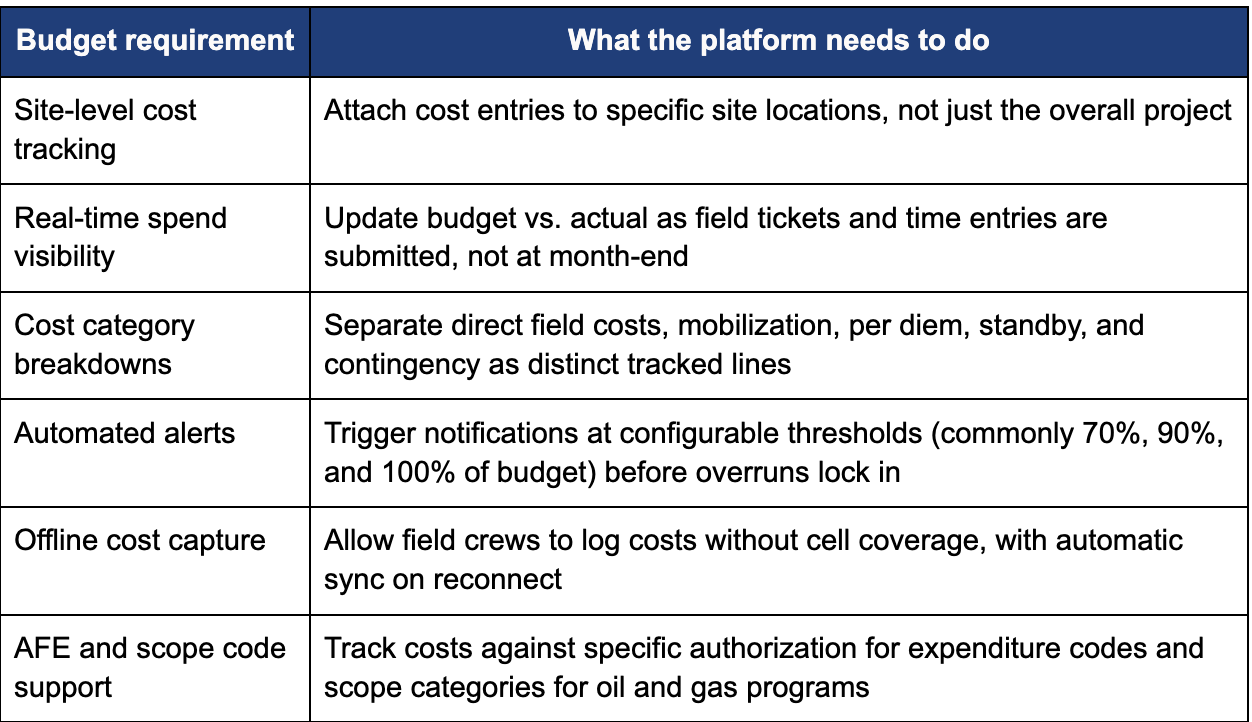
Platforms that track budget only at the project level cannot tell a project manager whether an overrun is coming from mobilization, per diem, or productive field work. That granularity requires cost codes or categories attached to individual entries, aggregated automatically as entries come in, visible in real time before the month-end reconciliation cycle.
Budget tracking that lags the work is not budget tracking
The standard field operations accounting cycle involves field tickets submitted at the end of the week, processed by an office administrator, and reviewed by the project manager several days after the work happened. By the time a cost issue is visible, the crew has often already accumulated additional costs in the same category.
Real-time budget tracking requires daily cost entries submitted by field crews and office staff in the same platform, with automatic aggregation visible to the project manager as entries arrive. Unlike spreadsheets and accounting systems that surface budget data five to seven days late, a purpose-built field operations platform tracks spending in real time as it happens.
For remote site programs where every additional crew-day carries mobilization-scale overhead, the difference between catching an overrun on day three and catching it on day ten is the difference between a manageable variance and a project that finishes significantly over budget.
Frequently Asked Questions
What costs do most field operations budgets miss for remote sites?
The categories most commonly omitted or underestimated are mobilization and demobilization broken into specific line items, per diem and accommodation at remote-specific rates, equipment standby during weather or access delays, crew travel time billed as labor, and the cost of returning to site to correct field data errors. When these are missing from the initial budget, they appear as overruns rather than planned costs.
How should mobilization costs be budgeted for remote field programs?
Mobilization should be broken into individual components with actual quotes rather than estimated as a lump sum. The primary components are equipment transport, temporary facilities, temporary utilities, site preparation labor, permits and access fees, and demobilization. For most commercial field programs, mobilization runs between 2% and 10% of total contract value, with remote sites trending toward the higher end of that range. Budgeting each component separately makes it possible to track actual mobilization costs against estimates and improve future bids.
What is a reasonable contingency for a remote site field operations budget?
Industry guidance for remote field programs frequently recommends starting at 20% contingency as a baseline, with higher reserves for programs in isolated areas, poor weather seasons, or complex regulatory environments. This contingency should sit above a separately budgeted standby reserve for weather and access delays, which is distinct from contingency for scope changes or unforeseen site conditions.
How does real-time budget tracking work for field operations?
Real-time budget tracking requires field crews and office staff to submit cost entries, time, and expenses through the same platform as field task management, with automatic aggregation to project and site-level budget views as entries arrive. Purpose-built field operations platforms update budget versus actual in real time and trigger automated alerts at configurable thresholds such as 70%, 90%, and 100% of budget, giving project managers time to act before overruns compound. This is structurally different from accounting systems or spreadsheets that consolidate costs at week-end or month-end.
What budget structure works best for remote field operations programs?
A four-layer structure provides the most useful visibility: direct field costs including labor, equipment, and materials; remote site overhead including mobilization, per diem, crew travel, and temporary facilities; a standby and weather reserve calibrated to site-specific conditions; and a remaining contingency for scope changes and unforeseen conditions. Separating remote site overhead from direct costs makes it possible to identify during execution whether overruns are coming from productive work or from logistical costs, which is the information needed to make corrective decisions while the program is still running.
Ready to Track Remote Site Costs in Real Time?
For field operations teams managing remote programs in oil and gas, environmental consulting, or infrastructure, Matidor's project management and field operations tools are built for exactly this: site-level budget tracking, real-time cost visibility, automated threshold alerts, and offline-first field data capture that works without cell coverage. See also Matidor's solutions for oil and gas and solutions for environmental services.
Additional reading: Field Project Budget Overruns: 5 Root Causes and Fixes and Field Operations Software Buyer's Guide 2026.
- Start a free 14-day trial and set up your first remote site budget with real-time cost tracking in under a day
- Book a demo to see site-level cost codes, automatic budget alerts, and offline field ticket capture configured for your programs
- Evaluate platform fit with Matidor's self-guided discovery tool
.webp)
.webp)
.webp)
.webp)
.webp)
.webp)
.webp)
.webp)
.webp)
.webp)
.webp)
.webp)
.webp)
.webp)
.webp)
%20(2).webp)
.webp)
.webp)
.webp)

















.webp)

.webp)

.jpg)


%20(1).webp)




.jpg)

.jpg)
.jpg)
.jpg)


.jpg)