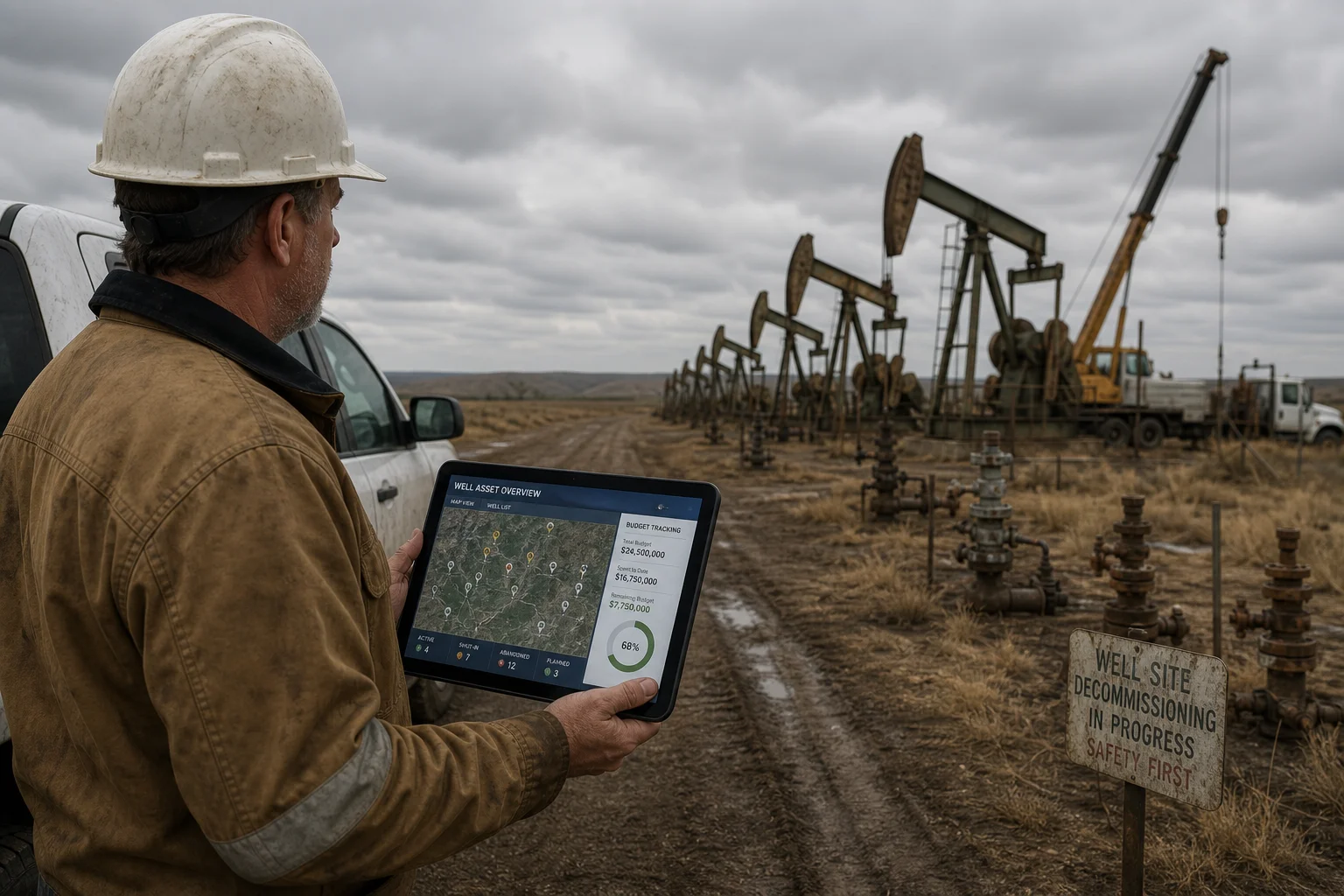

Managing one well is easy. Managing 400 is a different problem
Plugging a single well is a bounded, well-understood task with a clear scope, a known cost range, and a defined regulatory checklist. Plugging and reclaiming 400 wells across multiple regions, contractors, and regulatory jurisdictions over five to ten years is a portfolio management problem, and most operators are still running it with the tools built for the single-well version.
Median decommissioning costs run around $20,000 for plugging alone and $76,000 when surface reclamation is included, with costs varying widely by depth, age, and location. Multiply that across a portfolio of hundreds of wells staggered over a multi-year closure timeline, and the tracking problem stops being about individual well cost and starts being about program sequencing, contractor capacity, budget pacing, and regulatory deadline compliance across the entire inventory at once.
Regulators across major oil and gas jurisdictions have moved toward binding, calendar-based closure timelines rather than open-ended obligations, and liability funds tied to unmanaged or orphaned wells have grown substantially in recent years. These are not soft targets. They are deadlines with financial penalties attached, and they apply per site across an entire portfolio, not just to the wells an operator happens to be actively working on this quarter.
Why spreadsheet-based tracking breaks down at scale
Status categories multiply faster than tools can track them
A single well moves through multiple regulatory status categories over its life: producing, suspended, inactive, dormant, decommissioned, assessed, and reclaimed, each with its own regulator-defined criteria and deadline. On a portfolio of a few dozen wells, tracking each well's current status and next deadline in a spreadsheet is manageable. On a portfolio of hundreds, a single missed status update means a missed deadline, and a missed deadline on a regulated timeline carries direct financial and permitting consequences.
Contractor and crew capacity becomes the bottleneck
Well abandonment work requires specialized crews and equipment, plugging rigs, cementing crews, site reclamation contractors, that are shared across every active site in a program. When abandonment is tracked as a series of isolated work orders rather than a coordinated program, operators lose the ability to see where crews and equipment could be batched across geographically close sites to reduce mobilization costs, a cost category that scales directly with how many separate mobilizations a program requires.
Budget visibility lags behind spending
Well abandonment budgets typically span multiple cost categories: downhole plugging, wellhead and equipment removal, contamination assessment, remediation, and revegetation, each billed by different contractors on different schedules. When these costs are reconciled monthly rather than tracked in real time, a program that is overspending on one region often is not visible until well after the budget variance has become difficult to correct.
Documentation gaps surface at the worst possible time
Regulators expect time-stamped, traceable documentation for every step of decommissioning, not just a final closure certificate. When field documentation lives across contractor emails, paper forms, and disconnected spreadsheets, reconstructing a complete audit trail for a regulator inquiry or a liability transfer review becomes a multi-week research project instead of a report export.
Structuring a well abandonment program at portfolio scale
Build a single inventory with regulatory status attached
Every well in the portfolio needs to sit in one system with its current regulatory status, dormancy date, applicable decommissioning deadline, and estimated liability visible at a glance. Because closure obligations are inherently spatial, tied to geographic region, watershed proximity, and land use, a map-based view of the inventory makes it far easier to spot which wells share a regulatory deadline or geographic cluster than a flat spreadsheet list does.
Group wells into programs, not one-off work orders
Wells with similar abandonment methods, shared access roads, or overlapping regulatory deadlines should be grouped into a single program rather than dispatched as individual work orders. Programmatic grouping reduces the number of separate mobilizations required, which directly reduces the mobilization cost category that scales with every additional standalone trip to a remote site.
Track budget by category, not by total program cost
A well abandonment budget rolled up into a single number per program hides which cost category, downhole plugging, surface reclamation, or remediation, is driving an overrun. Separating budget tracking by category across the whole portfolio lets a program manager see whether reclamation costs are consistently running over estimate across every well in a region, which is the kind of pattern that only becomes visible at scale.
Standardize field documentation across every contractor
Every crew working across the program, whether internal or contracted, needs to complete the same structured checklist and capture the same categories of data: photos tied to GPS coordinates, activity logs, and lab results where applicable. Consistent documentation across contractors is what makes a portfolio audit-ready when a regulator, lender, or acquiring company requests closure records for the full inventory rather than a single site.
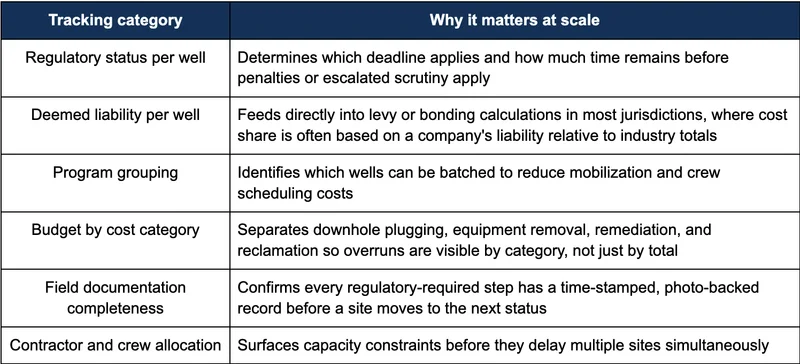
What to track across a well abandonment portfolio
The cost of managing abandonment reactively
Onshore well abandonment costs typically range from $20,000 to $150,000 per well depending on depth and location, with some wells exceeding $2 million where extensive remediation is required. When a portfolio-level program lacks coordinated tracking, the costs that compound are rarely the plugging costs themselves. They are the costs of missed regulatory deadlines, uncoordinated mobilizations that could have been batched, and the eventual cost of reconstructing documentation for a liability review or acquisition due diligence process that a real-time system would have already had assembled.
Operators managing dozens or hundreds of wells increasingly need the same portfolio-level visibility that large multi-site field operations programs use elsewhere in oil and gas and environmental services: a single map-based system of record, budget tracking by category, and standardized field documentation that syncs automatically from the field, rather than a patchwork of spreadsheets reconciled after the fact.
Frequently Asked Questions
How much does it cost to abandon an oil and gas well?
Onshore well abandonment typically ranges from $20,000 to $150,000 per well depending on depth, age, and location, with median costs around $20,000 for plugging alone and $76,000 when surface reclamation is included. Costs increase substantially with well depth, with each additional 1,000 feet of depth adding roughly 20% to total cost.
What regulatory deadlines apply to well abandonment?
Most major oil and gas jurisdictions now assign binding decommissioning, assessment, and restoration deadlines tied to when a well became inactive or dormant, replacing older open-ended obligations. Liability management frameworks and orphan well funding programs, supported by annual levies or bonding requirements, similarly push operators toward proactive closure planning ahead of orphan status.
How is well abandonment project management different from managing a single well closure?
Managing a single well closure is a bounded task with a known scope. Managing abandonment across hundreds of wells is a portfolio problem requiring coordinated scheduling of shared contractor and equipment resources, budget tracking across multiple cost categories simultaneously, and regulatory status tracking for every well against its own individual deadline, all of which spreadsheet-based tools struggle to scale.
Why does mobilization cost matter more on large abandonment programs?
Each standalone site visit for a plugging crew or reclamation contractor carries mobilization costs that do not scale down with the size of the well. Grouping geographically close wells with similar abandonment methods into a single program reduces the total number of mobilizations required across a portfolio, which is one of the most controllable costs in a multi-well closure program.
What documentation do regulators require for well abandonment?
Regulators require time-stamped, traceable records for every step of decommissioning, including deactivation, wellbore plugging, equipment removal, contamination assessment, remediation, and revegetation, not just a final sign-off that work is complete. This documentation needs to be consistent across every contractor working within a program to support audit and liability transfer review.
Ready to Manage Your Well Abandonment Portfolio at Scale?
For operators managing well abandonment programs across dozens or hundreds of sites, Matidor's oil and gas solutions and field operations platform bring inventory tracking, program-level budget management, and standardized field documentation into a single GIS-native system of record.
Additional reading: Orphan Well Liability in Canada: What Operators Need to Know in 2026 and AFE Tracking for Oil and Gas Field Operations.
- Start a free 14-day trial and map your first well abandonment program with live budget and status tracking
- Book a demo to see portfolio dashboards, category-level budget tracking, and offline field documentation configured for your abandonment inventory
.webp)
.webp)
.webp)
.webp)
.webp)
.webp)

.webp)
.webp)
.webp)
.webp)
.webp)
%20(2).webp)
.webp)
.webp)
.webp)

















.webp)

.webp)


.jpg)


%20(1).webp)




.jpg)

.jpg)
.jpg)
.jpg)


.jpg)