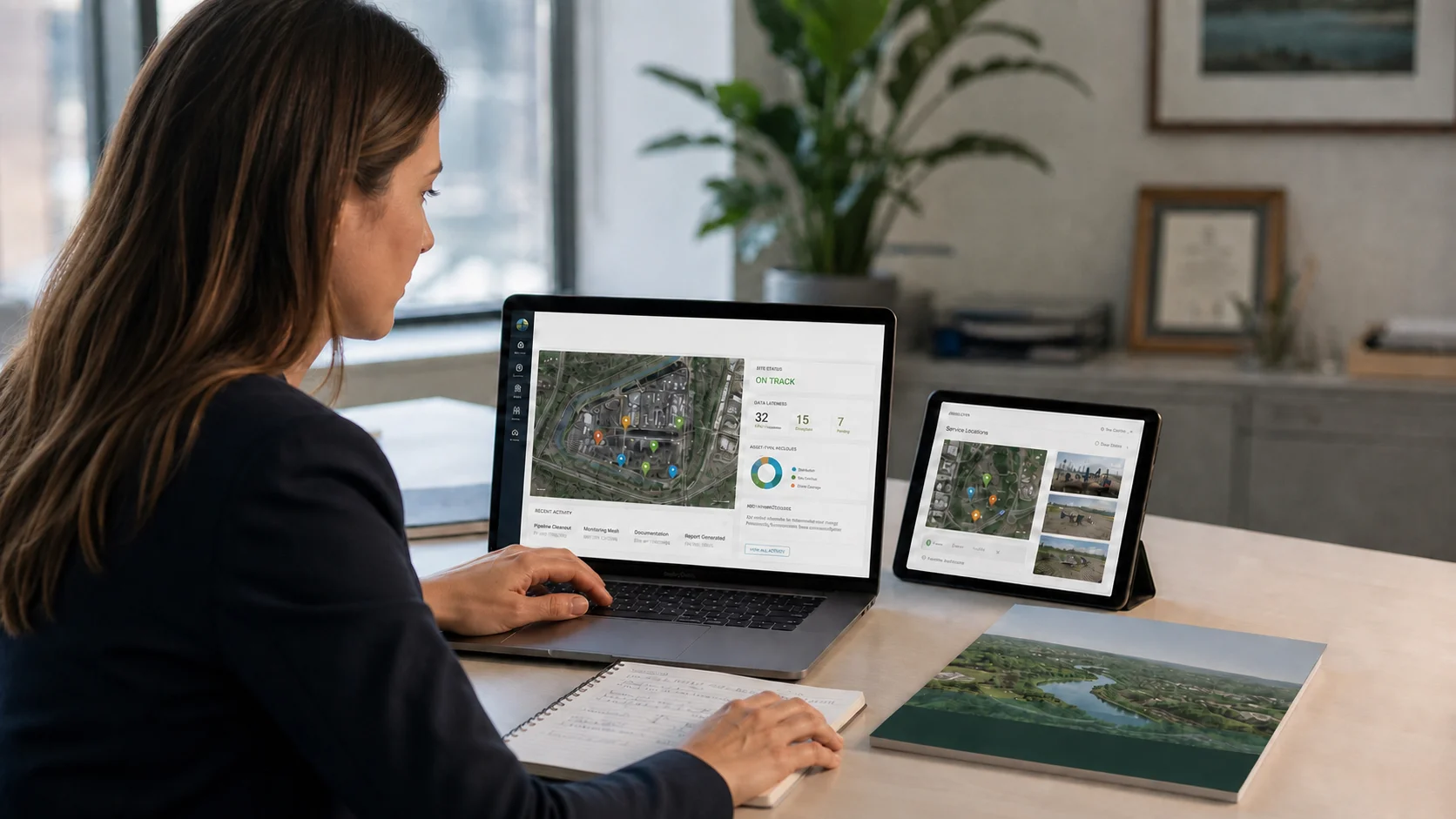

A client doesn't experience your fieldwork. They don't see the borehole logs, the sample collection, or the GPS points logged at 6 a.m. in the rain. What they experience is the report that arrives weeks later, and whatever gaps, inconsistencies, or delays show up in that document become their entire impression of how the project went.
This is the part of environmental consulting that rarely gets the same attention as the fieldwork itself, even though it's the part clients actually judge. A technically flawless site investigation can still leave a client frustrated if the deliverable is late, inconsistent with what they were told verbally, or missing the context they needed to make a decision.
The trust gap between fieldwork and the final report
Ask any project manager at a consulting firm where their time goes in the final two weeks of a project, and report writing is almost always near the top. Industry guidance suggests project management activities, which includes report preparation and client communication, typically consume somewhere between 7% and 15% of total project cost, and a meaningful share of that is spent reconciling field data that wasn't captured or organized cleanly the first time.
That reconciliation work is invisible to the client, but its absence is not. When a firm has to spend three extra days matching sample IDs to lab results because they came from two different systems, that's three days added to the timeline the client is watching. When a report references a monitoring well that doesn't match the coordinates in the appendix, the client doesn't see a data entry error. They see a firm that isn't paying attention.
Clients consistently rank fast, reliable, and transparent service delivery as their top priority when working with a service provider, and environmental consulting is no exception. The problem is that "fast and reliable" isn't primarily a writing problem. It's a data problem that shows up at the writing stage.
Where the gap actually starts
It starts in the field, not at the desk. Every extra hour spent cleaning up field data before it can go into a report is an hour that was lost days or weeks earlier, when a sample was logged inconsistently, a photo wasn't tagged to a location, or a field form used slightly different terminology than the last technician's form. None of these are dramatic failures. They're small inconsistencies that compound.
It continues through disconnected systems. A typical project might pull data from a field data collection app, a separate lab portal, a GIS platform for mapping, and a project management tool for status tracking. None of these are wrong tools individually, but stitching them together at report time is where hours disappear and errors creep in.
It surfaces in the client's inbox as silence. Clients don't need daily updates on sampling activities, but they do need to know when something changes: a scheduling delay, a scope adjustment, a preliminary finding that affects a decision they're waiting on. Firms that only communicate at the report delivery stage are asking clients to wait weeks for information that could have been shared incrementally.
What actually builds client trust
Trust in a consulting relationship isn't built by writing a polished executive summary. It's built by a client having an accurate sense of where a project stands at any given point, and receiving a deliverable that matches what they were told to expect.
A few things consistently separate firms clients describe as reliable from firms clients describe as frustrating to work with:
Clients get status visibility without having to ask for it. Rather than emailing a project manager to check on progress, clients who can see a live project status, whether through a shared dashboard or a simple recurring update, don't build up the anxiety that turns into a difficult conversation later.
Data flows into the report the same way it was collected. When field data, lab results, and site photos are already organized and geo-referenced by the time report writing starts, the writing process becomes assembly rather than detective work. This alone tends to be the biggest driver of both turnaround time and error rate.
Deliverables are consistent across projects and staff. A client working with the same firm across multiple sites notices immediately if one project's reports look different from another's, or if one project manager's updates are more detailed than another's. Standardized reporting templates and data structures make a firm look larger and more dependable than it might actually be.
Bad news travels as fast as good news. Environmental consulting deliverables sometimes carry legal weight. Delivery of a consultant's report can trigger limitation periods for a client's legal claims, meaning the report itself is not just informational, it has consequences. Clients trust firms that flag issues proactively over firms that only communicate on schedule.
A practical way to think about the reporting pipeline
Consider the reporting pipeline as three connected stages rather than one final task.
The first stage is field capture, where data quality is determined. If sample IDs, GPS coordinates, and field observations are captured consistently and immediately, most of the reconciliation problem simply doesn't exist later.
The second stage is data consolidation, where information from different sources, field forms, lab results, GIS layers, gets merged into a single, coherent dataset. This is traditionally the most time-consuming and error-prone stage, largely because it happens manually across disconnected tools.
The third stage is deliverable assembly, where the actual client-facing report gets written. When the first two stages are handled well, this stage becomes what it should be: writing and interpretation, not data archaeology.
Firms that struggle with client trust are almost always losing time and accuracy in the second stage, consolidation, and it shows up as delays and inconsistencies in the third.
Common questions from consulting teams
How much of a project's cost typically goes toward reporting and project management?
Industry estimates place project management and reporting activities, taken together, at roughly 7% to 15% of total project cost depending on complexity, with a widely cited baseline of around 10% for the project management function alone. A meaningful share of that time on many projects goes toward reconciling data that wasn't organized consistently at the point of collection.
Why do environmental consulting deliverables sometimes take longer than clients expect?
Delays usually trace back to data consolidation, not writing. When field data, lab results, and mapping information live in separate systems, matching and verifying that information before it can be presented consumes far more time than clients realize, and that time is largely invisible to them until the deadline slips.
Does report delivery timing have legal implications for environmental consultants?
In some jurisdictions, the delivery of a consultant's report or opinion has been found to trigger the start of a client's limitation period for related legal claims. This makes accurate, well-documented, and clearly dated deliverables more than a client service issue. It can carry direct legal consequences for both the consultant and the client.
What's the fastest way for a firm to improve client trust without overhauling its entire workflow?
Improving visibility into project status, even through simple, consistent updates, addresses the client's biggest source of frustration: not knowing where things stand. This can be implemented well before a firm tackles the harder problem of consolidating field data collection and reporting systems.
Turn Your Field Data Into Reports Clients Actually Trust
If your team is losing days to data reconciliation instead of writing, the fix isn't a better report template. It's fixing what happens before the report gets written.
Matidor connects field data collection, GIS mapping, and project status into a single system, so by the time your team sits down to write, the data is already clean, organized, and geo-referenced. No more matching sample IDs across three tools. No more clients emailing to ask where a project stands.
- Book a demo and see how consolidated field data turns into client-ready deliverables in a fraction of the time
- Start a free 14-day trial and run your next project's data collection and reporting in one connected workflow
.webp)
.webp)
.webp)
.webp)
.webp)
.webp)
.webp)
.webp)
.webp)
.webp)
.webp)
.webp)
%20(2).webp)
.webp)
.webp)
.webp)















.webp)

.webp)

.jpg)

%20(1).webp)




.jpg)

.jpg)
.jpg)
.jpg)

.jpg)