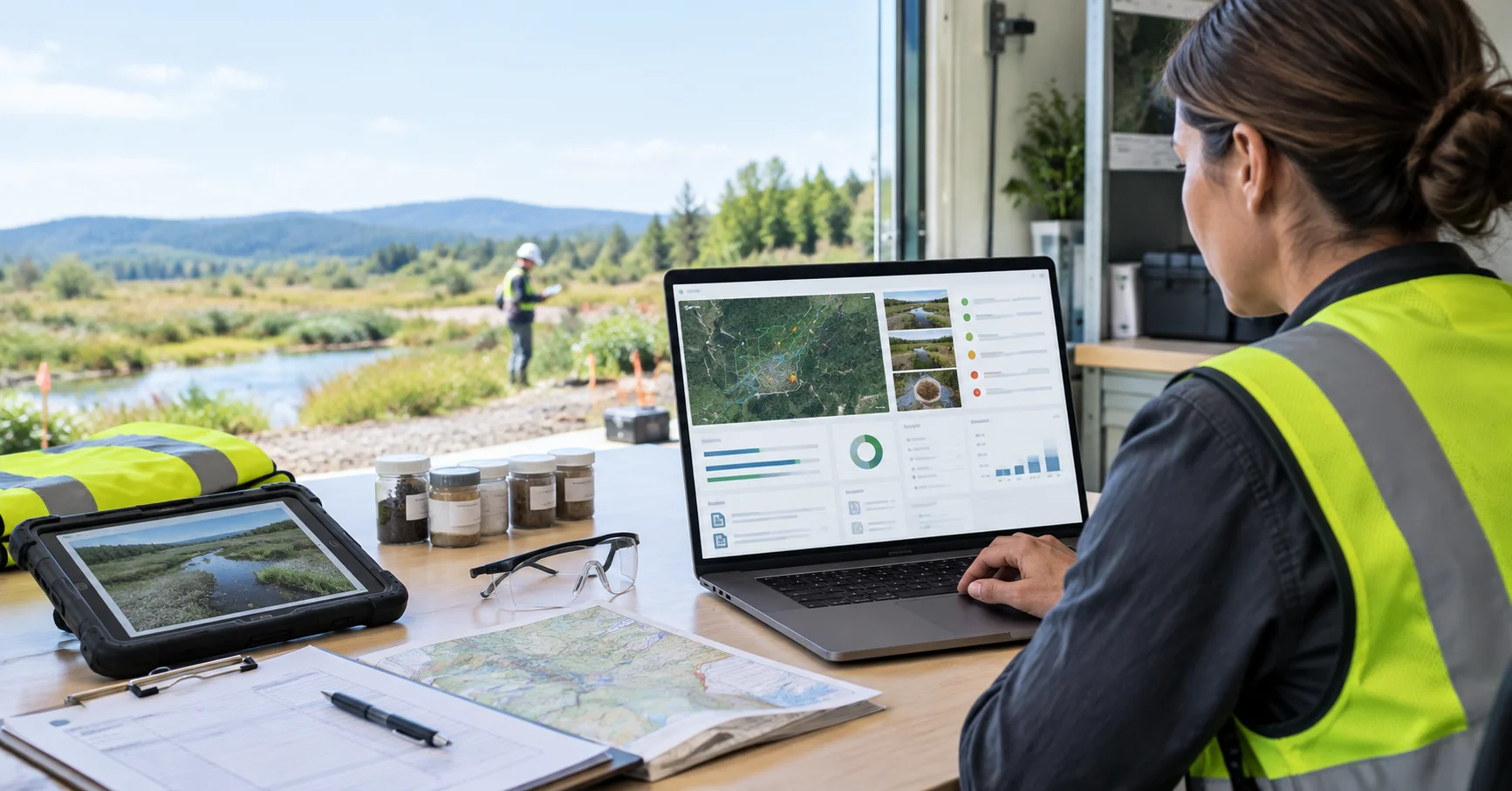

For years, the final report has been treated as the main reporting experience in environmental consulting.
Fieldwork happens. Data is collected. Laboratory results arrive. Technical reviews are completed. Then the client receives a polished PDF explaining what happened.
That model is changing.
In 2027, clients will expect more than a strong document at the end of the project. They will judge consultants by the visibility and traceability available throughout delivery.
The final PDF will still matter. It simply will not be the entire reporting experience.
Reporting Starts in the Field
Environmental reporting begins long before anyone writes an executive summary.
It begins when a technician records an observation, collects a sample, takes a photograph, completes a form, or marks a location on a map.
Problems appear when those records become separated.
A photograph sits in a shared drive. A field form arrives as an email attachment. Sample information lives in a spreadsheet. Project coordinates are stored in GIS. Laboratory results are delivered through another system. Review comments remain in someone’s inbox.
The final report may eventually bring those pieces together, but the team must first reconstruct the relationships between them.
Clients will increasingly expect those connections to exist earlier.
A project location should connect to the relevant observation. An observation should connect to its photographs, forms, tasks, and supporting documents. A sample should remain traceable to where and when it was collected.
The evidence behind a finding should be easy to retrieve without searching across multiple systems.
The strongest reporting workflow will not begin with assembling a PDF. It will begin with preserving connected field evidence from the moment it is captured.
Collected Does Not Mean Ready
A folder full of field records does not mean a project is ready to report.
Some observations may still need clarification. Photographs may be missing labels. Laboratory results may have arrived but not been reviewed. A map may be complete while the supporting interpretation remains in progress.
Without a visible review process, data that has been collected can easily be mistaken for data that is ready.
Clients may not need access to every internal technical discussion, but they will expect the consultant to know what has been:
- Collected
- Submitted
- Reviewed
- Approved
- Returned for correction
- Included in a deliverable
- Left outstanding
Review status gives project managers a more accurate picture of reporting readiness.
It also helps technical teams identify gaps before report production begins. A missing photograph, incomplete form, unresolved sample identifier, or unreviewed observation is easier to address while the work is still current.
The final report should not be the first point at which the team discovers that supporting evidence is incomplete.
Environmental consulting reporting in 2027 will depend on whether a consultant can show not only what information exists, but also whether it has passed the appropriate review.
Progress Needs Budget Context
A project can appear operationally healthy while its financial position is deteriorating.
Fieldwork may be complete, but additional analysis is consuming unplanned hours. A technical deliverable may be nearly finished, but subcontractor costs have not been reconciled. A client may hear that the project is on track without knowing that most of the budget has already been used.
That separation between progress and cost creates an incomplete picture.
A useful project update should make it possible to understand:
- What work has been completed
- What remains outstanding
- Which deliverables are approaching
- How much of the budget has been used
- Whether the remaining budget matches the remaining work
- Which changes could affect cost or schedule
This does not mean every client needs access to internal financial details.
It means consultants need current budget context before they communicate project status.
When technical progress and financial progress are reviewed together, project teams can identify problems earlier. Scope changes become easier to explain. Forecasts become more credible. Clients receive fewer surprises at invoicing or project closeout.
Reporting readiness is not only about whether the evidence is complete. It is also about whether the project remains aligned with the agreed scope, schedule, and fee.
Visibility Will Come Earlier
Traditional reporting creates long periods of limited visibility.
The consultant is working. The client knows activity is underway. Meaningful information arrives during a scheduled update or after a deliverable is issued.
That may work for a short assignment. It becomes less effective for multi-site programs, remediation work, recurring monitoring, or projects involving several field teams and stakeholders.
By 2027, more clients will expect controlled visibility before the final report.
That visibility may include:
- Current project phase
- Recently completed fieldwork
- Upcoming milestones
- Open decisions
- Outstanding evidence
- Review status
- Budget position
- Emerging schedule or scope risks
The goal is not to expose every draft note or create a constant stream of unfiltered field information.
Clients need the right level of visibility, not unlimited access.
A well-designed reporting experience should distinguish internal working information from client-ready updates. Technical teams need room to collect, interpret, and review. Clients need confidence that the work is progressing and that important changes will be communicated early.
Earlier visibility should reduce reporting friction, not create more of it.
The Final Report Should Confirm
The best final reports should not surprise the client.
Important findings may still emerge during analysis, but the client should already understand the project’s progress, major constraints, evidence status, and important decisions.
By the time the PDF arrives, it should confirm a project story the client has been able to follow throughout delivery.
That changes the role of the final document.
It remains the formal record of methods, findings, interpretation, and recommendations. But it no longer needs to carry the entire burden of project communication.
When field evidence is connected, review status is visible, budget context is current, and client updates happen earlier, the final report becomes easier to prepare and easier to trust.
The PDF is no longer where project visibility begins.
It is where the documented project record comes together.
Build Readiness Into Delivery
Reporting readiness is not a task added near the end of a project.
It is an operating condition built throughout the work.
Field information must be captured consistently. Supporting evidence must remain connected to the correct project and location. Review status must be visible. Budget information must stay aligned with project progress. Client-ready updates must be available before the final deliverable.
This is where disconnected tools create unnecessary work.
If field records, maps, tasks, documents, review steps, and budgets live in separate systems, every status update requires another round of collection and reconciliation.
Matidor brings project locations, field information, tasks, documents, workflows, and budget visibility into one map-based workspace. Teams can use current project information to assess reporting readiness and give clients clearer visibility throughout delivery.
The goal is not to replace technical judgment or reduce environmental reporting to a dashboard.
It is to make sure the evidence, context, and project controls behind the final report are ready before writing begins.
In 2027, the strongest environmental consultants will not wait until the final PDF to demonstrate control.
Their clients will be able to see it throughout the project.
Make Every Project Report-Ready
Connect field evidence, project status, review workflows, documents, and budget context in one map-based workspace.
Give your team a clearer view of what is complete, what still needs attention, and what clients need to know before the final report.
Book a demo to see how Matidor supports reporting readiness across environmental projects.
Start a free 14-day trial and explore Matidor with your own projects and workflows.
.webp)
.webp)
.webp)
.webp)
.webp)
.webp)
.webp)
.webp)

.webp)
.webp)
.webp)
.webp)
.webp)
.webp)
%20(2).webp)
.webp)
.webp)
.webp)

















.webp)

.webp)

.jpg)


%20(1).webp)




.jpg)

.jpg)
.jpg)
.jpg)


.jpg)