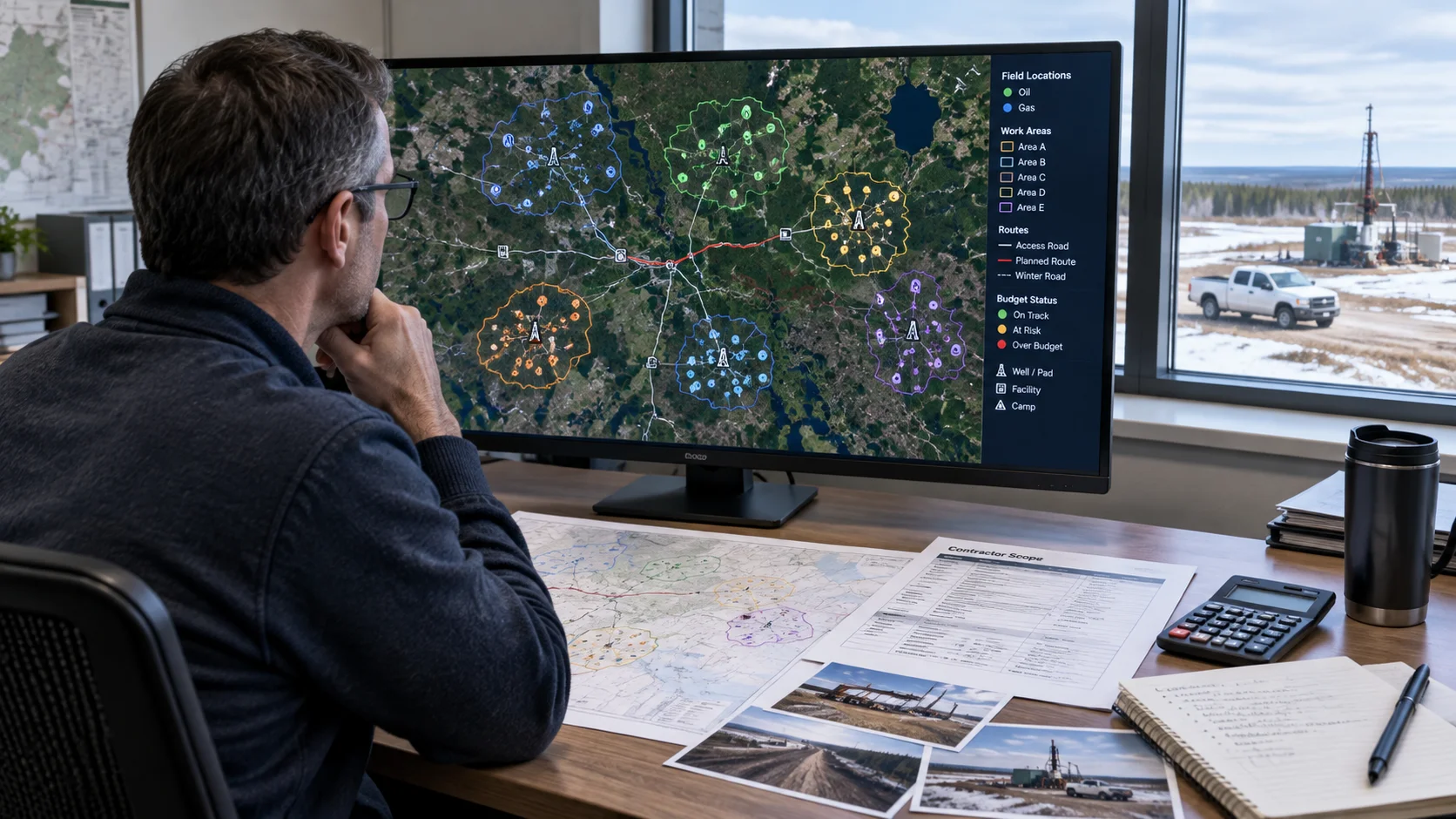

A 2027 field program budget can balance perfectly and still be difficult to execute.
The problem usually starts when planned spending is separated from the locations, work scopes, contractors, assumptions, and field conditions behind it.
A spreadsheet may show how much has been allocated to abandonment, remediation, reclamation, compliance, or maintenance. It may not show where that work will happen, which sites can be grouped, what each estimate assumes, or whether contractor capacity exists when the work is scheduled.
That is the visibility gap in oil and gas field program budgeting.
A defensible program budget should answer five questions before field activity begins:
- What work is planned?
- Where will it happen?
- Which contractor or crew will perform it?
- What assumptions support the estimate?
- How will actual costs be connected to the original plan?
If those answers live in separate systems, budget confidence is often higher than operational readiness.
Start With the Map
Field programs are geographic by nature.
Travel distances, site access, seasonal restrictions, nearby infrastructure, environmental constraints, and contractor mobilization all affect the cost of getting work done. Yet many annual budgets are still assembled by asset category or accounting code before anyone evaluates the geographic pattern of the program.
That reverses the planning process.
Before assigning dollars, producers should map the sites being considered for 2027. Each location should connect to its proposed activity, priority, current status, access conditions, regulatory drivers, and expected field window.
The map may reveal that several individually reasonable projects form an inefficient program.
Sites may be spread across distant operating areas. One location may require winter access while another is best completed during dry summer conditions. A small work package may sit far from every other planned activity, making mobilization disproportionately expensive.
The opposite can also happen.
A geographic cluster may create an opportunity to coordinate crews, equipment, inspections, sampling, or contractor mobilization. The Alberta Energy Regulator’s historical area-based closure work found that grouping closure activities could create operational efficiencies and reduce costs through collaboration and economies of scale. Participants also identified predictable closure budgets as valuable for multi-year planning.
The map should shape the budget, not simply illustrate it after approval.
Budget the Work, Not the Site
A site is not a complete budget unit.
The same location may require several different activities, each with its own scope, timing, contractor, and cost assumptions. A well may need downhole abandonment. Surface equipment may need removal. Environmental assessment may identify remediation work. Reclamation may continue across multiple field seasons.
Assigning one amount to the site can hide those differences.
A stronger 2027 field program budget separates the work into defined packages, such as:
- Well abandonment
- Facility decommissioning
- Pipeline work
- Phase 1 or Phase 2 environmental assessment
- Remediation
- Reclamation
- Vegetation management
- Monitoring
- Regulatory inspections
- Compliance maintenance
Each package should connect to a location and a defined outcome.
This allows program managers to see whether the budget funds a complete path toward closure or only one stage of a longer process. It also prevents the same activity from being counted twice under different departmental plans.
Regulatory requirements make this level of detail increasingly important. Alberta’s 2026 industry-wide closure spend requirement was $750 million, with licensee-specific spending assigned through the Inventory Reduction Program. The AER also allowed qualifying excess spending from 2025 or 2026 to be banked for use in 2027.
In British Columbia, permit holders with dormant or former sites must prepare annual work plans identifying which sites will be decommissioned, assessed, or restored and when the work is expected to occur.
A budget built only around a total closure allocation cannot provide that operational detail.
Make Assumptions Visible
Every estimate depends on assumptions.
The risk is not that assumptions exist. The risk is that they disappear after the budget is approved.
A reclamation estimate may assume clean soil, straightforward access, and no additional monitoring. An abandonment estimate may assume a standard equipment configuration. A remediation allowance may use historical averages before investigation results are available.
Those estimates may be appropriate for planning, but they should not appear more certain than the available information supports.
Each major work package should record the assumptions that materially affect cost. These may include:
- Site access and road conditions
- Mobilization distance
- Seasonal timing
- Equipment requirements
- Labour rates
- Contractor availability
- Waste volumes
- Disposal locations
- Laboratory requirements
- Landowner coordination
- Regulatory submissions
- Known environmental conditions
- Scope exclusions
- Contingency triggers
This makes the program budget easier to review and adjust.
If access changes, the program manager can identify every estimate that used the original assumption. If investigation results increase the expected remediation scope, the affected location can be updated without treating the entire annual budget as unreliable.
A defensible budget does not pretend uncertainty has been eliminated. It shows where uncertainty exists and how it has been funded.
Connect Contractors Early
A field program is not operationally ready simply because money has been allocated.
The work also needs people, equipment, and capacity.
Producers may build annual plans using internal estimates, previous invoices, or standard unit rates. Those estimates can become unrealistic if the required contractors are unavailable during the planned season or if several projects compete for the same specialized resources.
Contractor planning should therefore happen while the budget is being built.
Each work package should identify the expected contractor, procurement status, rate basis, mobilization assumptions, and likely execution window. Where the contractor has not been selected, the budget should indicate whether the estimate comes from a current quote, historical average, rate sheet, or planning allowance.
This creates a more honest distinction between:
- Scoped and quoted work
- Scoped but unquoted work
- Conceptual allowances
- Regulatory commitments
- Optional work
- Contingency work
Without that distinction, tentative estimates can appear as firm commitments.
Connecting contractors to locations also helps identify regional capacity constraints. A producer may discover that several projects require the same environmental consultant, abandonment crew, or specialized equipment within a short period.
That is a scheduling issue, but it is also a budget risk.
Design for Actual Costs
Actual cost visibility begins during budget design, not after the first invoice arrives.
If the approved budget uses one structure and contractors submit costs using another, reconciliation becomes a manual interpretation exercise.
The program may be approved by region and work type, while invoices arrive by contractor, date, or purchase order. Field tickets may reference local site names rather than official asset identifiers. Internal time may be recorded against a general cost centre instead of the specific work package.
The total cost may eventually reach finance, but the operational meaning is lost.
Before field activity begins, the producer should define how every cost will connect to:
- The correct location
- The approved work package
- The contractor
- The purchase order or AFE
- The relevant cost category
- The completion status
- The original estimate
This creates continuity between planning and execution.
When actual costs use the same structure as the approved program, managers can see which locations are complete, which scopes have changed, and whether remaining funds still match remaining work.
Real-time budget visibility is most useful when cost entries, project scopes, and field activity remain connected to the same locations rather than being reconciled across separate tools.
Place Contingency Where Risk Lives
A single contingency percentage is easy to calculate. It is not always easy to defend.
Field program uncertainty is rarely distributed evenly.
One region may have mature scopes and current contractor quotes. Another may contain remote locations with limited access data. A remediation program may depend on analytical results that are not yet available. A reclamation project may have significant weather or landowner risk.
Applying the same contingency rate to every project can overfund predictable work and underfund uncertain work.
A better approach connects contingency to specific risk drivers.
A work package with a current quote, verified access, and established scope may require less contingency. A conceptual project with uncertain waste volumes, access limitations, or unresolved regulatory requirements may need more.
This allows decision-makers to understand why contingency exists and what events may consume it.
It also makes future adjustments easier. When an uncertainty is resolved, the associated contingency can be released or reassigned with a documented reason.
Build a Program You Can Defend
Before approving the 2027 budget, producers should be able to move from the portfolio total to the individual field activity without losing context.
For every planned dollar, the program should show:
- The location
- The proposed work
- The reason it is included
- The expected timing
- The responsible contractor or crew
- The estimate source
- The scope assumptions
- The applicable contingency
- The cost structure that will receive actuals
That does not guarantee that every project will proceed exactly as planned.
It creates a budget that can adapt without losing its history.
If priorities change, managers can see which sites and obligations are affected. If contractor rates increase, they can identify the exposed work packages. If field conditions expand the scope, they can trace the variance back to the original assumption.
This is what makes a field program budget geographically and operationally defensible.
It is not only a financial target. It is a connected plan for where work will happen, what will be done, who will do it, and how the organization will know whether delivery still matches the approved program.
Matidor brings project locations, field scopes, tasks, contractor information, documents, and budget visibility into one map-based workspace. This gives producers a clearer way to build the program before fieldwork begins and maintain the connection between planned work and actual delivery.
A strong 2027 budget should not force operations teams to reconstruct the plan after approval.
The operational logic should already be visible.
Book a demo to see how Matidor connects multi-site field programs, project scopes, contractors, and budget information on one map.
Start a free 14-day trial and explore Matidor with your own projects and workflows.
.webp)
.webp)
.webp)
.webp)
.webp)
.webp)
.webp)
.webp)
.webp)

.webp)
.webp)
.webp)
.webp)
.webp)
.webp)
%20(2).webp)
.webp)
.webp)
.webp)

















.webp)

.webp)


.jpg)


%20(1).webp)




.jpg)

.jpg)
.jpg)
.jpg)


.jpg)