.webp)

The scramble is predictable. The response usually isn't
Every fall, the same pattern repeats across field operations teams working remote sites. A short window of good weather and stable access starts closing, and suddenly every unfinished sampling round, every deferred inspection, and every site that still needs a fall visit before freeze-up gets crammed into six overbooked weeks. Crews get double-booked. Equipment that should have been reserved in July gets fought over in September. Someone realizes too late that a site's winter road access closes before the scheduled visit.
None of this is a surprise. Weather-driven delays affect roughly 45% of construction and field projects worldwide every year, and climate and environmental conditions account for a meaningful share of all project delay causes. The problem isn't that fall weather is unpredictable. It's that most field teams plan season to season instead of building a full-year capacity and access plan that treats fall crunch as the known, recurring event it actually is.
For remote programs, the stakes are higher than on urban job sites. Remote and constrained environments introduce access and logistics risks that cannot be resolved once work is already underway. They have to be planned for from the outset, because a missed access window on a remote site doesn't just delay a task, it can push an entire deliverable into the following year.
Why remote field programs feel the fall scramble hardest
Access windows are hard deadlines, not soft targets
Many remote sites are only reachable during specific seasonal windows: before spring breakup, after a winter road freezes solid enough to bear equipment, or during a narrow open-water season for barge or sealift delivery. Winter road campaigns can shift or shorten by weeks depending on the season, and once a corridor closes, there is no way to force access until the next window opens. A field program that treats these windows as flexible rather than fixed ends up planning work that becomes physically impossible to complete on schedule.
Weather-sensitive tasks get pushed to the same narrow calendar
Sampling, drilling, vegetation assessments, and equipment inspections that all depend on dry ground, stable temperatures, or ice-free water tend to cluster into the same few months every region has. When every crew, every client, and every regulatory deadline is competing for the same short season, capacity constraints that were invisible in June become critical in September.
Crew and equipment demand spikes without warning
Crew scheduling chaos is rarely caused by any single job. It's caused by a lack of a rolling, multi-week lookahead that would have flagged conflicts before they became urgent. On remote programs, this is compounded by the fact that mobilizing a crew to a fall site carries the same travel, per diem, and equipment mobilization costs as any other trip, so a poorly sequenced fall push doesn't just strain people, it multiplies logistics costs at the exact time margin for error is lowest.
Contingency planning happens after the delay, not before it
Most field teams document weather delays well after they happen, using a daily log or an as-built entry, rather than building expected weather and access risk into the original schedule. This after-the-fact tracking is useful for justifying a missed deadline to a client or regulator, but it does nothing to prevent the deadline from being missed in the first place.
What proactive seasonal planning actually requires
Build a seasonal access map before the year starts
Every remote site in a program's portfolio has its own access profile: road-accessible year-round, winter-road only, open-water season only, or fly-in only. Mapping every active site against its access window at the start of the year, rather than site by site as visits come up, makes it possible to see which sites have the shortest windows and need to be prioritized first, not last.
Use historical weather and access data to build real buffer days
Historical weather data can be used to calculate the average number of weather-impacted days per month for a specific region over the past five to ten years, and that data should be built directly into the schedule as planned non-working days rather than treated as an unplanned risk. On remote programs, this same logic needs to extend beyond weather to access: how many days per season has a given winter road historically opened later or closed earlier than planned.
Sequence fall-critical work first, not last
Sites with the narrowest fall access windows, or work that must happen before freeze-up, need to be scheduled early in the fall planning cycle, not squeezed in after summer work runs long. A rolling multi-week lookahead that surfaces crew and equipment conflicts before they happen is what separates a program that adapts smoothly from one that discovers a scheduling conflict the week a crew was supposed to mobilize.
Build a floating capacity buffer into crew and equipment planning
Leaving buffer capacity, whether that is a flex crew, reserved equipment days, or unallocated budget, for the highest-risk weeks of the season is what allows a program to absorb a weather delay or access delay without cascading into every other scheduled site visit. Programs that treat every crew and every piece of equipment as fully booked with no slack are the ones most likely to lose an entire site visit to a single bad week.
Track actual versus planned access and weather impact all year
Comparing actual weather and access days against what was planned, month over month, is what turns next year's seasonal plan into something based on real regional data rather than a repeat of this year's guesswork. Programs that skip this step are doomed to relearn the same fall crunch every year instead of building a seasonal buffer that reflects their specific sites and history.
Seasonal planning checklist for remote field programs
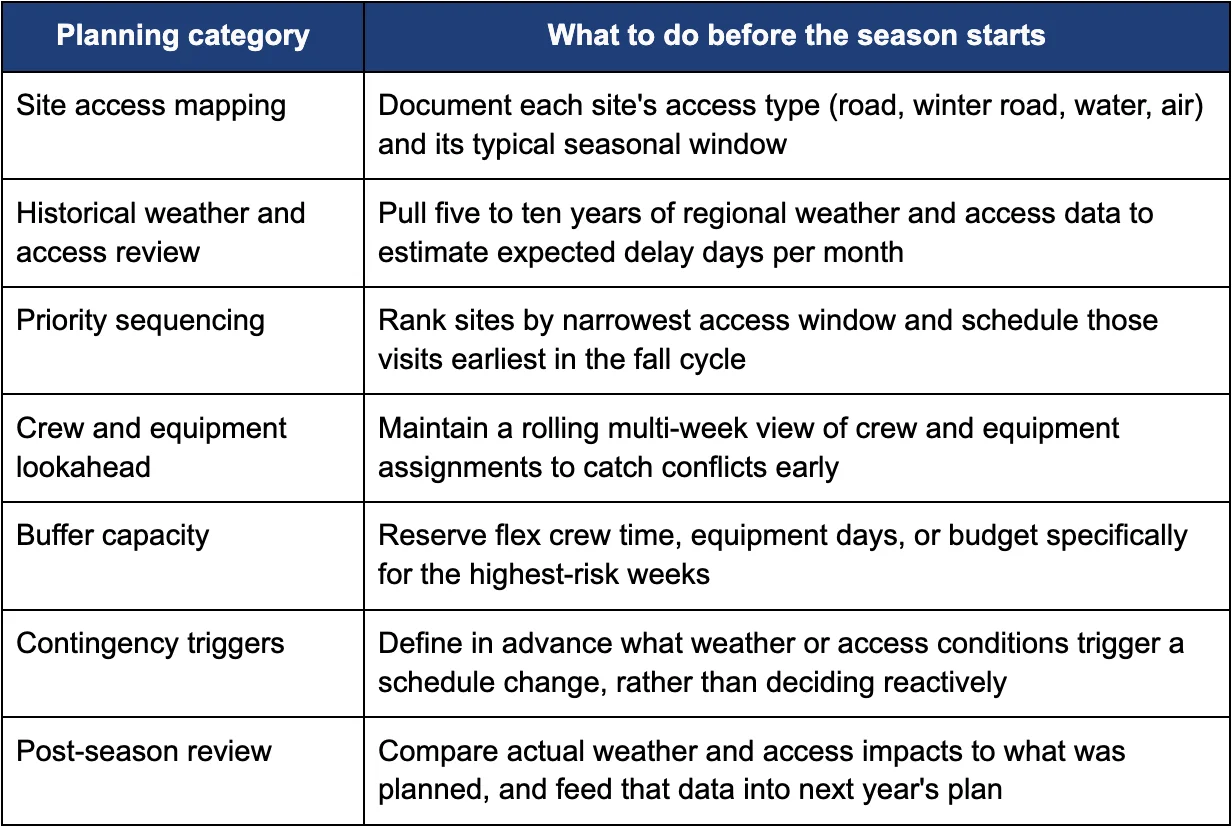
What this looks like when it works
A field program with a mapped seasonal access plan does not eliminate weather risk. What it eliminates is the scramble that happens when every unfinished task from the whole year suddenly needs to happen in the same six-week window. Sites with the tightest access windows get visited first. Crews are scheduled against a plan that already accounts for typical delay days instead of assuming a perfect season. When a storm or an early freeze does hit, there's buffer capacity to absorb it instead of a full cascade of rescheduled visits.
This is the same portfolio-level thinking that field operations teams increasingly apply to multi-site budget tracking and well abandonment programs: a single, mapped view of every site's constraints, updated continuously, rather than a plan built fresh and reactively every time a deadline gets close.
Frequently Asked Questions
Why do field programs experience a fall scramble every year?
Fall scrambles happen because weather-sensitive and access-limited work gets scheduled reactively across the whole season instead of being sequenced against known seasonal access windows from the start. Weather delays affect roughly 45% of field and construction projects annually, and when every deferred task from spring and summer gets pushed into the same narrowing fall window, crews, equipment, and access windows all compete for the same limited weeks.
How far in advance should remote field programs plan for seasonal access?
Seasonal access planning should happen at the start of the field year, not the start of fall. Sites with the narrowest access windows, such as winter-road-only or open-water-season-only locations, need to be identified and prioritized months before their access window opens so scheduling conflicts can be resolved early rather than discovered at mobilization.
How can historical weather data improve field program scheduling?
Pulling five to ten years of regional weather and access data allows a program to estimate the average number of delay days expected per month and build that into the schedule as planned buffer time rather than unplanned risk. This turns weather delay from a reactive surprise into a quantified, budgeted part of the schedule.
What is the difference between crew planning and crew scheduling for field programs?
Crew planning is the longer-term, strategic process of forecasting staffing needs and workforce distribution across a season, while crew scheduling is the shorter-term, tactical process of assigning specific people to specific jobs based on current availability. Remote field programs need both: a seasonal capacity plan built early, and a rolling multi-week schedule that adapts to it as the season progresses.
What happens if a remote site's seasonal access window is missed?
Missing an access window on a remote site, such as a winter road that only supports heavy equipment for a few weeks, or an open-water season for barge delivery, typically means the site cannot be reached again until the next seasonal window opens, which can be many months later. This makes seasonal access planning fundamentally different from urban field work, where a missed date usually just means a short reschedule.
Ready to Plan Your Field Season Before It Plans You?
For field operations teams managing multiple remote sites with varying seasonal access, Matidor's project management and field operations platform bring site-level access mapping, crew and equipment scheduling, and real-time status tracking into a single system, so seasonal planning happens once at the start of the year instead of being rebuilt every time a deadline closes in.
Additional reading: How to Build a Field Operations Budget That Accounts for Remote Site Costs and Well Abandonment Project Management: Tracking Costs and Compliance Across Hundreds of Wells.
- Start a free 14-day trial and map your first seasonal access plan across all active sites
- Book a demo to see rolling crew scheduling, site access mapping, and buffer capacity planning configured for your field program
.webp)
.webp)
.webp)
.webp)
.webp)
.webp)
.webp)
.webp)
.webp)
.webp)
.webp)
.webp)
%20(2).webp)
.webp)
.webp)
.webp)

















.webp)
.webp)

.jpg)

%20(1).webp)




.jpg)

.jpg)
.jpg)
.jpg)


.jpg)